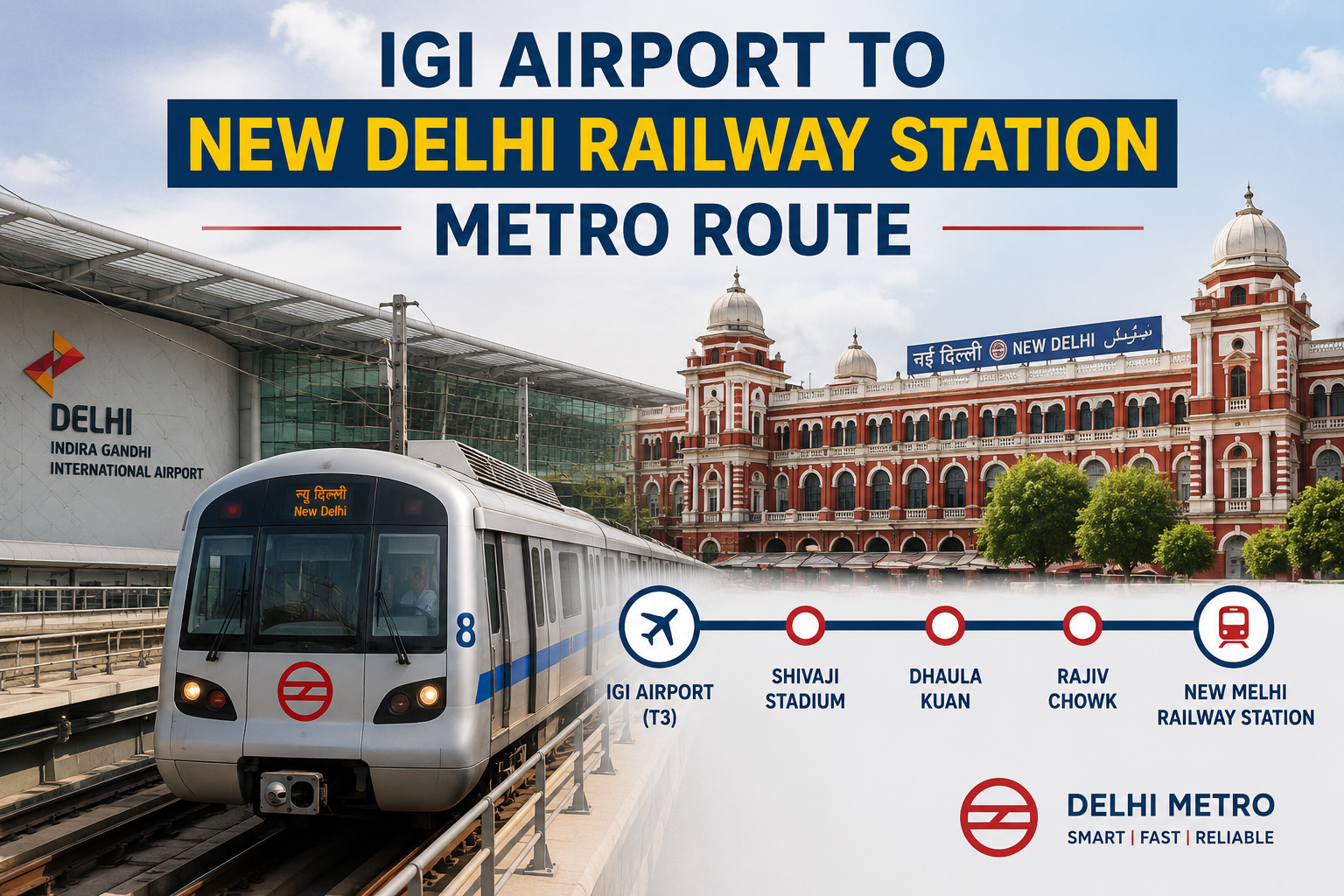
Landed at IGI Airport with a train to catch from New Delhi Railway Station? You’re in luck — this is one of the easiest cross-city connections in Delhi, and you don’t need to touch a road at all to make it happen.
The Airport Express Line (Orange Line) runs a direct, no-change service between IGI Airport and New Delhi Railway Station, and it consistently beats every other option on the clock. No traffic signals, no jams near ITO or Ring Road, no guessing how long the ride will take — just a straight run on dedicated tracks.
This guide walks you through everything you actually need: the stations in between, what a ticket really costs, how long to budget, when the first and last trains run, and a few things seasoned travelers know that first-timers usually don’t.
Quick Summary
If you’re short on time, here’s the whole route in one glance.
| What You Need to Know | Details |
|---|---|
| From | IGI Airport Metro Station |
| To | New Delhi Metro Station |
| Line | Airport Express (Orange Line) |
| Change of trains? | None — it’s a direct run |
| Stations covered | 5, including both ends |
| Distance | Roughly 20 km |
| Journey time | 19–23 minutes |
| Fare (token) | ₹60 |
| Fare (smart card) | About 10% cheaper |
| First train | Around 4:45 AM |
| Last train | Around 11:30 PM |
| Frequency | Every 10–15 minutes |
Why the Airport Express Line Is Worth Choosing
Delhi has a handful of ways to get between the airport and the city center, but the Airport Express Line was purpose-built for exactly this trip. It runs on its own dedicated corridor — it doesn’t share tracks with the regular Delhi Metro network — which is why it manages speeds that a normal metro line simply can’t.
The trains are also a notch above standard metro coaches: wider luggage racks, extra legroom near the doors, and screens showing live flight information at some stations. If you’re arriving with suitcases, this matters more than it sounds — regular metro coaches at rush hour are not fun with two checked bags.
Trains run in a single, continuous direction: New Delhi ⇄ Dwarka Sector 21, with IGI Airport sitting roughly in the middle. So whichever direction you’re heading, just look for trains marked toward “New Delhi” on the platform display.
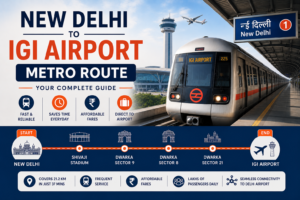
The Five Stations Along the Way
Here’s exactly what you’ll pass through, in order, from the airport to the railway station:
| # | Station | Notes |
|---|---|---|
| 1 | IGI Airport | Located inside Terminal 3; also accessible from Terminal 1 |
| 2 | Delhi Aerocity | Hotel and business district — many airport-area hotels are a short walk or shuttle from here |
| 3 | Dhaula Kuan | Major road junction, close to Delhi Cantonment |
| 4 | Shivaji Stadium | Handy stop if you’re headed toward Connaught Place |
| 5 | New Delhi | Directly linked to New Delhi Railway Station |
You won’t need to get off at any of these — they’re simply the stops the train makes on its way through. The whole ride covers about 20 kilometers end to end.
What a Ticket Actually Costs
Airport Express fares sit a little higher than the regular Delhi Metro network, which makes sense given the dedicated infrastructure and faster trains. Here’s the breakdown:
| Ticket Type | Cost |
|---|---|
| Paper token | ₹60 |
| Smart card (stored value) | Roughly 10% less than token fare |
| QR code / app ticket | Available at station kiosks and the DMRC app |
If you already carry a Delhi Metro smart card from previous trips, use it — the small discount adds up, and you skip the token counter entirely. First-time visitors without a card can pick up a token at any counter or vending machine; both accept cash and UPI at most stations.
One thing worth knowing: keep your token or QR code until you exit at New Delhi station. The flap gates need it to let you out, and losing it mid-journey means a trip to the station office to sort things out — not what you want when you’re racing to catch a train.
How Long Should You Actually Budget?
Officially, the journey takes somewhere between 19 and 23 minutes, depending on the exact train and time of day. In practice, most travelers clock it closer to 20 minutes door-to-door on the platform.
That said, build in extra time on either end:
- Security screening at IGI Airport station adds a few minutes, especially during peak hours.
- Walking from the airport terminal to the metro platform can take 5–10 minutes depending on which terminal you’re arriving at.
- At New Delhi station, the walk to the railway station’s platforms (especially if you need to cross to the other side) can take another 10–15 minutes.
So while the train ride itself is fast, a realistic total buffer of 45 minutes to an hour from touchdown to boarding your train is a safer bet than cutting it to the bare 20-minute journey time.
First Train, Last Train, and How Often They Come
| Timing | |
|---|---|
| First service | Around 4:45 AM |
| Last service | Around 11:30 PM |
| Peak frequency | Every 10 minutes |
| Off-peak frequency | Every 15 minutes |
If you’re on an early-morning flight or arriving on a late-night one, this line is one of the few Delhi transit options running that early or that late — which is exactly why it’s popular with airport staff and frequent flyers, not just tourists.
Step by Step: From Landing to Platform
For anyone doing this route for the first time, here’s how the whole thing typically plays out:
- Follow the metro signage as soon as you clear the arrivals area — it’s well marked at all three terminals.
- Buy your token or tap your smart card at the entry gate. Vending machines are usually faster than the counter queue.
- Head down to the Airport Express platform and board any train marked toward New Delhi.
- Ride through Aerocity, Dhaula Kuan, and Shivaji Stadium — no action needed, just enjoy the AC and the view.
- Get off at New Delhi station and follow signs for the railway station exit — it connects directly, no need to step outside onto the road.
- Check your PNR and platform number on the railway station’s display boards once you’re through, since New Delhi Railway Station has two sides (Ajmeri Gate and Paharganj), and your platform could be on either.
That last point trips up a lot of first-time travelers — know which side of the station your platform is on before you arrive, since crossing over inside a crowded station eats up time you might not have.
Metro vs. Cab: Which Should You Actually Take?
It’s a fair question, especially if you’ve got heavy luggage or a tight connection. Here’s how they stack up:
| Factor | Airport Express Metro | Cab / Taxi |
|---|---|---|
| Typical travel time | 20–25 minutes (fixed) | 40–70+ minutes, traffic-dependent |
| Cost | ₹60 or less | ₹400–₹700 depending on surge pricing |
| Reliability | Very high — unaffected by traffic | Unpredictable during peak hours |
| Luggage handling | You carry your own | Door-to-door, no walking |
| Best for | Solo travelers, light packers, budget-conscious trips | Groups, heavy luggage, late-night arrivals when trains have stopped |
For most solo or light-luggage travelers, the metro wins on both time and cost, especially during Delhi’s notorious peak-hour traffic. If you’re traveling with a family and multiple suitcases, or arriving after the last train, a cab still makes sense.
What’s Around New Delhi Railway Station
Once you’re out, you’re already close to some of Delhi’s best-known areas:
| Place | Roughly How Far |
|---|---|
| Connaught Place | 2 km |
| Paharganj Market | Walking distance |
| Janpath Market | 3 km |
| India Gate | 4 km |
| Karol Bagh Market | 5 km |
If your train isn’t for a few hours and you’ve got time to spare, Paharganj’s market lanes are literally a few minutes’ walk from the station exit — handy for a quick bite or last-minute shopping before boarding.
Facilities You’ll Actually Use
Both IGI Airport and New Delhi metro stations are built for exactly this kind of high-traffic, luggage-heavy travel:
- Escalators and lifts at every level, so stairs with suitcases aren’t a problem
- Smart card top-up counters and vending machines
- ATMs near the entry/exit gates
- Clean washrooms
- Security screening (standard airport-style check, so keep liquids accessible)
- A few food and snack counters, though options are limited compared to the airport terminals themselves
A Few Tips From Frequent Riders
- Traveling with heavy bags? Stick close to the lift rather than the escalator — it’s slower but far less stressful with suitcases.
- Flying internationally? Arrive at the airport metro station with enough buffer for both the ride and the walk to your terminal — international check-in counters often close 60 minutes before departure.
- Carrying cash? Token counters accept cash, but the smart card and UPI route is faster if you’re in a hurry.
- Unsure which exit to use at New Delhi station? Follow signage for “Railway Station” rather than the general city exits — it saves a walk around the building.
- Traveling late at night? Double-check the last train timing for your specific direction before you rely on it — timings can shift slightly, so it’s worth a quick check on the DMRC app if your trip is close to 11:30 PM.
Frequently Asked Questions
Does this route need any change of trains? No. It’s a single, direct ride on the Airport Express Line from start to finish.
How much should I budget for the fare? ₹60 for a token, slightly less if you’re using a smart card.
How long does the ride take? Roughly 19–23 minutes on the train itself, though allow closer to 45 minutes total once you factor in walking and security checks.
Is New Delhi metro station actually connected to the railway station? Yes — you can walk straight from the metro station into the railway station premises without stepping outside.
What time does the first and last train run? First trains start around 4:45 AM, and the last ones run until roughly 11:30 PM, with trains every 10–15 minutes in between.
Is this route worth it over a cab? For most travelers, yes — it’s faster, cheaper, and unaffected by Delhi’s traffic. Cabs make more sense with heavy luggage, large groups, or after the metro stops running for the night.
Final Word
For a straightforward, no-fuss connection between IGI Airport and New Delhi Railway Station, the Airport Express Line is hard to beat. It’s quick, predictably timed, reasonably priced, and drops you close enough to the railway station that you won’t be sprinting through traffic with a suitcase in tow.
Whichever direction you’re headed — off a flight and racing for a train, or coming from the station toward a departure — this route is built to get you there with time to spare.
Fares, timings, and frequency are subject to change by DMRC. It’s always a good idea to confirm current details on the official Delhi Metro app or at the station before you travel.