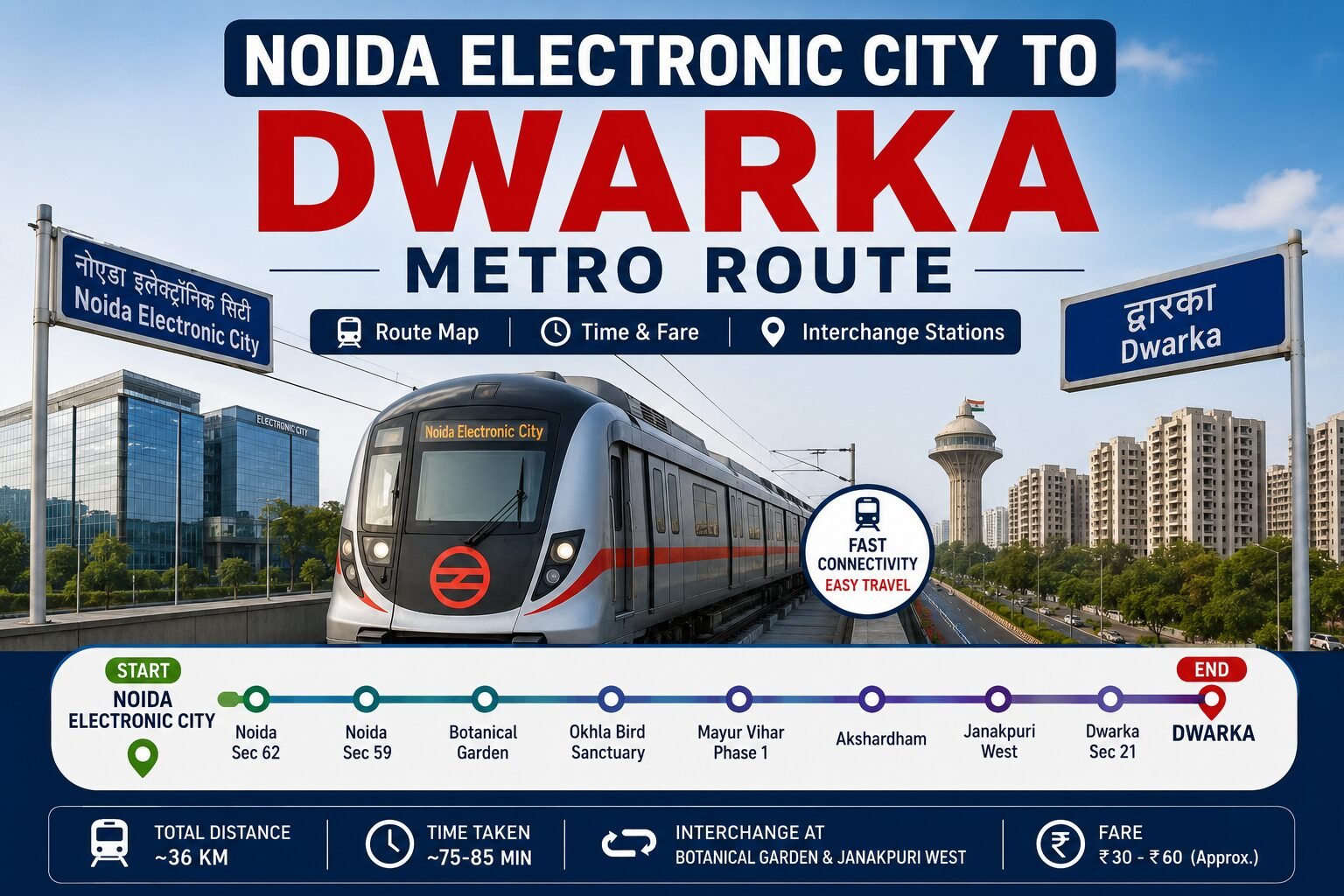
If you’re based near Noida Electronic City and need to get to Dwarka, you’re in for a pleasant surprise. Unlike most cross-city metro trips in Delhi that involve at least one line change, this particular journey is a straight shot. Both stations sit at the two opposite ends of the same corridor — the Blue Line — so you can board at one tip of the line and get off at the other without ever stepping onto a different platform.
That said, it’s also one of the longest single rides you can take on the Delhi Metro, so it helps to know what you’re signing up for before you tap in. Here’s a full breakdown of the route, the stations along the way, the fare, the timings, and a few things I’d tell a friend before they made this trip for the first time.
Quick Route Overview
| Detail | Information |
|---|---|
| Metro Line | Blue Line (Line 3 – Main Line) |
| Interchange Required | None — it’s a direct route |
| Total Distance | Approximately 56 km |
| Total Stations Covered | 50 stations end to end |
| Approx. Travel Time | Around 85–100 minutes |
| Fare (Token / UPI) | ₹60 |
| Fare (Smart Card) | Approximately ₹52–54 |
| First Train | Roughly between 5:30 AM and 6:00 AM |
| Last Train | Roughly between 11:00 PM and 11:45 PM |
Timings can shift slightly depending on the exact direction and day, so it’s always worth a quick check on the DMRC app before a very early or very late trip.
Why You Don’t Need to Change Trains on This Route
Noida Electronic City and Dwarka Sector 21 aren’t just two random stations that happen to be far apart — they’re the official termini of the Blue Line’s main corridor. Noida Electronic City marks the easternmost point of the line, tucked into Noida’s Sector 62–63 belt, an area known for its cluster of IT parks, BPOs, and the Jaypee Institute of Information Technology. Dwarka Sector 21, on the other end, marks the westernmost point, out past Delhi’s Dwarka sub-city.
Because both stations anchor the same line, a train heading toward Dwarka Sector 21 from Noida Electronic City stays on the Blue Line the entire way. You get on, find a seat if you can, and settle in for a fairly long but completely hassle-free ride.
Stations You’ll Pass Along the Way
You won’t need to memorize all 50 stops, but it helps to know the general shape of the journey. Here’s roughly how it unfolds, area by area.
Through Noida: Starting out from Noida Electronic City, the train works its way through the Sector 62 and Sector 59–61 belt before reaching Noida Sector 52, which is worth remembering if you ever need to hop onto the Aqua Line (the Noida–Greater Noida Metro) — the two systems connect here via a walkway. From there, the route continues past Noida City Centre and on toward Botanical Garden, a major junction where the Blue Line meets the Magenta Line.
Through Central Delhi: After crossing the Yamuna, you’ll pass Yamuna Bank — the point where the branch line toward Vaishali splits off — followed by stops like Akshardham, Indraprastha, and Supreme Court. Soon after comes Mandi House, an interchange with the Violet Line, and then Barakhamba Road before you roll into Rajiv Chowk, right under Connaught Place, where the Yellow Line crosses the Blue Line.
Through West Delhi: From here the train heads west through Jhandewalan, Karol Bagh (a well-known shopping stretch), Rajendra Place, Patel Nagar, and Shadipur. Kirti Nagar comes next, offering an interchange with the Green Line, followed by Moti Nagar and Ramesh Nagar. Rajouri Garden is another key stop, connecting to the Pink Line, before the train passes through Tagore Garden, Tilak Nagar, and on to Janakpuri West, which links up with the Magenta Line as well.
Into Dwarka: The final stretch takes you through Uttam Nagar and Dwarka Mor, then down through Dwarka’s numbered sectors one after another until you reach the terminus at Dwarka Sector 21 — which, handy to know, is also where you’d change for the Airport Express Line if IGI Airport’s Terminal 3 is your final destination.
Fare for This Route
For a journey this long, you’ll fall into the Delhi Metro’s highest distance-based fare slab.
- Token or UPI/QR ticket: ₹60 for a one-way trip
- Smart Card: Roughly ₹52–54, thanks to the standard 10% discount smart card holders get on every ride
- Off-peak smart card travel: An additional 10% off applies before 8 AM, between 12 PM and 5 PM, and after 9 PM, which can shave the fare down a little further
- Students and senior citizens: Eligible for a 50% concession with valid ID
- Children below 5 years: Travel free
If you’re making this trip often — say, for a daily office commute — a smart card pays for itself pretty quickly and also saves you the hassle of standing in the token line.
First Train, Last Train, and Frequency
Trains on this stretch generally start running a little before 6 AM and continue until around 11 PM to 11:45 PM, though the exact first and last train times differ slightly depending on which direction you’re travelling and which day of the week it is. During peak office hours, trains arrive roughly every 3–4 minutes, while off-peak frequency stretches out to about every 6–8 minutes. If you’re planning either a very early morning or a late-night journey, it’s worth double-checking the live schedule on the DMRC app or the One Delhi app so you’re not left waiting on the platform.
Tips for a Smoother Journey
Since this is one of the longer rides on the network, a bit of planning goes a long way:
- Travel off-peak if you can. Mid-morning or early afternoon trains are noticeably less crowded than the 8–11 AM and 5:30–8:30 PM rush, and you’re far more likely to find a seat for the long haul.
- Carry a smart card. Beyond the fare discount, it lets you skip the token counter entirely and breeze through the gates.
- Keep something to do handy. With a ride pushing close to an hour and a half, a book, playlist, or podcast makes the time pass a lot faster.
- Watch for your interchange cues, even if you’re not changing trains. Stations like Botanical Garden, Mandi House, Rajiv Chowk, Kirti Nagar, Rajouri Garden, and Janakpuri West are worth remembering in case your plans change mid-journey and you suddenly need another line.
- Heading to the airport? Get off at Dwarka Sector 21 and switch to the Airport Express Line for a quick run to IGI Airport Terminal 3.
- Luggage rule: One bag travels free; additional bags are charged separately, so keep that in mind if you’re heading out with more than a backpack.
Frequently Asked Questions
Do I need to change trains between Noida Electronic City and Dwarka? No. Both stations lie on the two ends of the Blue Line’s main corridor, so it’s a direct journey with zero interchanges.
How long does the trip actually take? Expect somewhere around 85 to 100 minutes end to end, depending on the time of day and how long the train dwells at each station.
What’s the total fare? ₹60 with a token, QR ticket, or UPI payment, and roughly ₹52–54 if you’re using a smart card.
How many stations are on this route? The full Blue Line main corridor between Noida Electronic City and Dwarka Sector 21 covers 50 stations.
Can I catch a flight from this route? Yes. Get off at Dwarka Sector 21 and interchange onto the Airport Express Line, which will take you straight to IGI Airport Terminal 3.
What’s the best time to travel to avoid crowds? Late morning (after 10 AM) or early afternoon tends to be quieter, along with the window after 9 PM.
Final Thoughts
For a route that spans two ends of the city, the Noida Electronic City to Dwarka metro journey is refreshingly simple — no interchanges, no confusing platform changes, just one long, steady ride across Delhi and Noida on the Blue Line. Keep a smart card handy, try to avoid the peak rush if your schedule allows it, and you’ve got one of the most convenient long-distance commutes the Delhi Metro has to offer.