If you have just stepped off a train at New Delhi Railway Station and need to get to Saket, you are in luck. This is one of the easiest cross-city metro journeys in Delhi. There is no interchange, no running between platforms, and no guessing which line to hop onto halfway through. You board once, sit back, and get off at Saket. That is about as simple as Delhi Metro travel gets.
I have written about a fair few metro routes on this site, and this one is worth a mention because so many people search for it every day, whether they are heading to Saket for a hospital visit, a court hearing, a mall trip, or simply going home after a long train journey. Here is everything you need to know before you set off.
Quick Route Overview
- Metro line used: Yellow Line (Samaypur Badli to Millennium City Centre Gurugram)
- Interchange needed: None, it is a direct journey on one line
- Total stations covered: 13, including New Delhi and Saket
- Approximate distance: Around 12 to 13 km
- Approximate travel time: 25 to 28 minutes, depending on how the trains are running
- Approximate fare: Around ₹40 by token, slightly less with a smart card
Fares and timings on the Delhi Metro do get revised from time to time, so treat the numbers above as a close estimate rather than gospel. The DMRC app or the fare chart at any station will always have the exact figure for the day you travel.
Getting to the Metro from New Delhi Railway Station
New Delhi Railway Station has two very different sides, and which one you land on decides how far you will walk.
If you come out from the Ajmeri Gate side (Platform 16 area), you are in luck. The New Delhi Metro Station entrance is practically next door, just a few minutes on foot. Follow the metro signage inside the station and you will reach the entry gates without much trouble.
If you come out from the Paharganj side instead, the metro entrance is roughly a kilometre away. Rather than walking all the way around outside, look for the foot overbridge inside the station that connects the two sides. It is quicker than it sounds and saves you from dealing with the traffic outside.
Either way, once you are inside New Delhi Metro Station, you are on the Yellow Line, and that is exactly the line you need for Saket.
Step by Step: The Route from New Delhi to Saket
Once you have your token or have tapped your smart card, head to the platform for trains going towards Millennium City Centre Gurugram (still commonly called HUDA City Centre by a lot of regular commuters, so do not be confused if you hear that name announced or see it on old signage). This is the southbound direction.
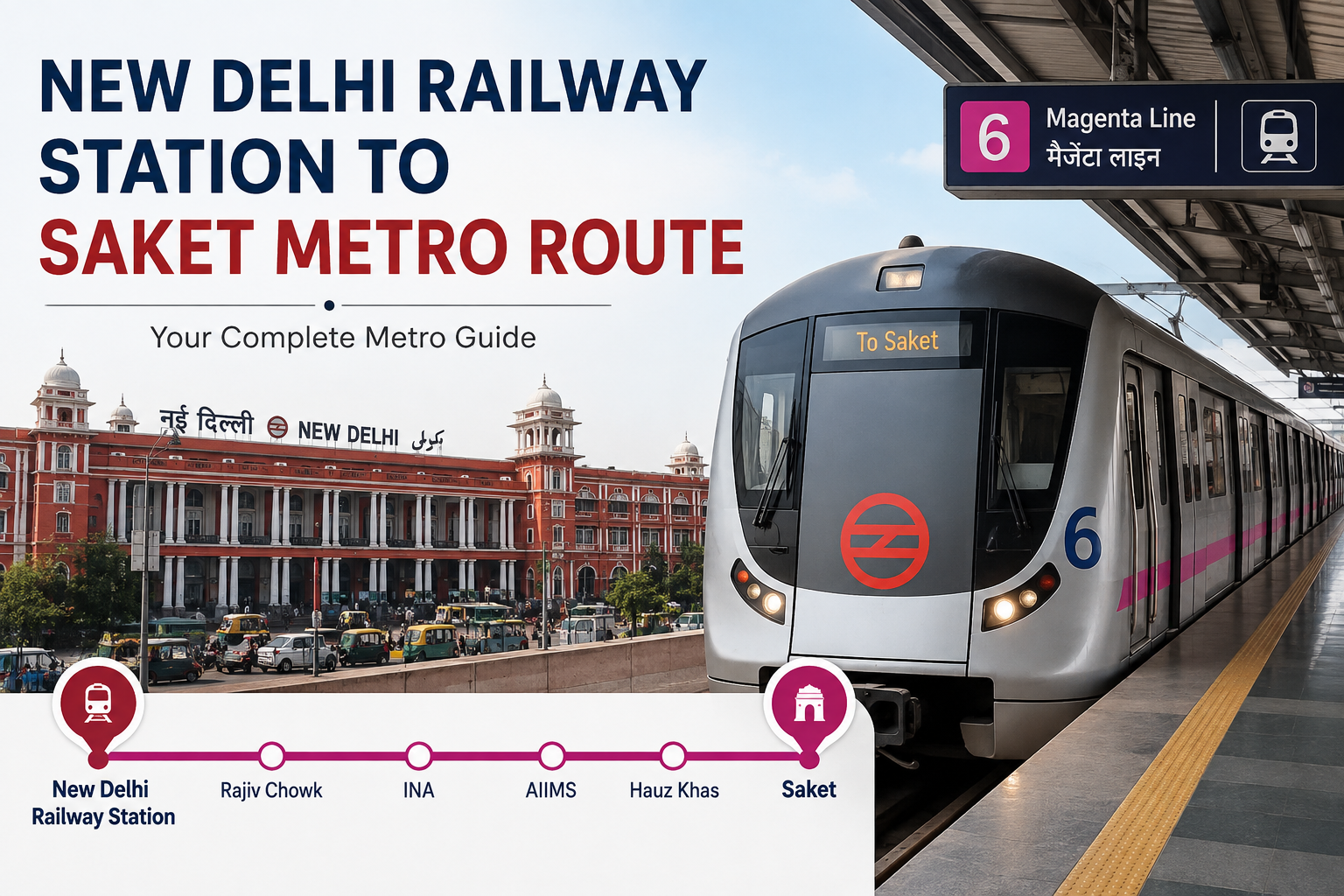
From there, the train will take you through these stations in order:
- New Delhi
- Rajiv Chowk
- Patel Chowk
- Central Secretariat
- Udyog Bhawan
- Lok Kalyan Marg
- Jor Bagh
- INA
- AIIMS
- Green Park
- Hauz Khas
- Malviya Nagar
- Saket
That is 11 stations in between your start and end point, and you stay seated through all of them. No changing trains, no crossing platforms. Just watch for the Saket announcement and step off.
A Few Interesting Stops Along the Way
Even on a straightforward ride, a couple of stations are worth knowing about, either because they are useful landmarks or because they connect to other parts of the city.
Rajiv Chowk comes up just two stops in, and it is the busiest interchange on the entire Delhi Metro network, connecting to the Blue Line. If you are travelling during office hours, expect the platform to be crowded here even though you are not getting off.
Central Secretariat is where the Yellow Line meets the Violet Line, useful to remember if a friend ever asks you how to reach areas like Lajpat Nagar or Kashmere Gate from this side of town.
INA connects to the Pink Line, and the station sits right next to Dilli Haat, the open-air craft and food market. Worth remembering for a weekend outing later.
Hauz Khas is an interchange with the Magenta Line and also happens to be one of the more popular hangout areas in South Delhi, with Hauz Khas Village just a short walk from the station.
AIIMS is exactly what it sounds like, the stop for the All India Institute of Medical Sciences, so the platform tends to be busy through the day.
None of these require you to actually get off unless that is your plan, but they make the ride a little more interesting than just counting down station names.
Fare and Ticket Options
Delhi Metro fares are calculated by distance travelled, not by the number of stations. For a journey in the 12 to 21 km range, which is where New Delhi to Saket falls, you are looking at somewhere around ₹40 for a single token.
A smart card works out cheaper thanks to the standard discount applied on every trip, and it also saves you the hassle of standing in a token queue, especially useful if you have just come off a long train ride and want to get moving quickly. If you do not already own one, smart cards are available at the customer service counter at New Delhi Metro Station itself.
QR-based mobile tickets through the DMRC app are another option if you would rather not carry a physical card or token at all.
First Train, Last Train and How Often They Run
Yellow Line trains generally start running from around 5:30 to 6:00 AM and continue until close to 11:30 PM, though exact first and last train timings can shift slightly, so it is worth a quick check on the DMRC app if you are travelling very early or very late.
During peak hours, roughly 8 to 11 AM and again from 5 to 9 PM, trains run every few minutes. Outside these windows, you will usually wait a little longer between trains, but rarely more than eight to ten minutes.
Travelling with Luggage
If you have just arrived by train, chances are you are not travelling light. The Delhi Metro does allow personal luggage within reasonable size and weight limits, but oversized suitcases, several large bags at once, or anything that will not comfortably go through the security scanner can slow you down or get flagged at the entry gate.
For a couple of medium bags, the metro works fine and is honestly the most economical way to make this trip. If you are carrying a lot more than that, or travelling with young kids and heavy luggage together, it might be worth considering a prepaid taxi or an app-based cab from outside the station instead. It costs more, but it saves you the trouble of managing bags through security lines and escalators.
What You Will Find Near Saket Metro Station
Saket is one of those areas that has grown into a proper commercial and residential hub over the years. Step out of the metro station and you are close to several well known malls, including Select Citywalk, DLF Place, and MGF Metropolitan Mall, all popular for shopping and eating out. The area is also home to the Saket District Courts and a cluster of hospitals, so a good number of the people using this route are headed there rather than the malls.
Depending on which exit gate you take, your actual walking distance to these places will vary, so it helps to check which gate is closest to your final destination before you get off the train.
Quick Tips for a Smooth Journey
- Board from the platform heading towards Millennium City Centre Gurugram, not Samaypur Badli.
- Keep some cash or a UPI option handy in case token counters have a queue.
- Avoid peak hours if you are carrying heavy luggage, the trains get genuinely packed.
- Check the exit gate number at Saket in advance if you are heading to a specific mall, hospital, or the court complex.
- Download the DMRC app before you travel, it gives live train timings and the exact current fare.
Frequently Asked Questions
Is there a direct metro from New Delhi Railway Station to Saket? Yes. Both stations are on the Yellow Line, so you do not need to change trains at any point.
How long does the journey take? Roughly 25 to 28 minutes under normal conditions, though delays during peak hours are possible like on any busy urban metro system.
How many stations are there between New Delhi and Saket? Eleven stations in between, with New Delhi and Saket being the first and last stops of this particular journey.
Which metro station is nearest to New Delhi Railway Station? The New Delhi Metro Station itself, located right next to the Ajmeri Gate side of the railway station.
Can I use the same smart card for this entire journey? Yes, a Delhi Metro smart card works across the whole network, including this route, with no separate ticket needed for any interchange since there isn’t one here.
Final Word
Of all the metro routes I have covered on this blog, New Delhi to Saket is genuinely one of the most traveller-friendly. One line, no changes, a fairly quick ride, and you land right in the middle of a busy, well connected part of South Delhi. Whether you are here for work, a hospital appointment, or just to catch a movie at Select Citywalk, the Yellow Line has you covered from the moment you step off your train.