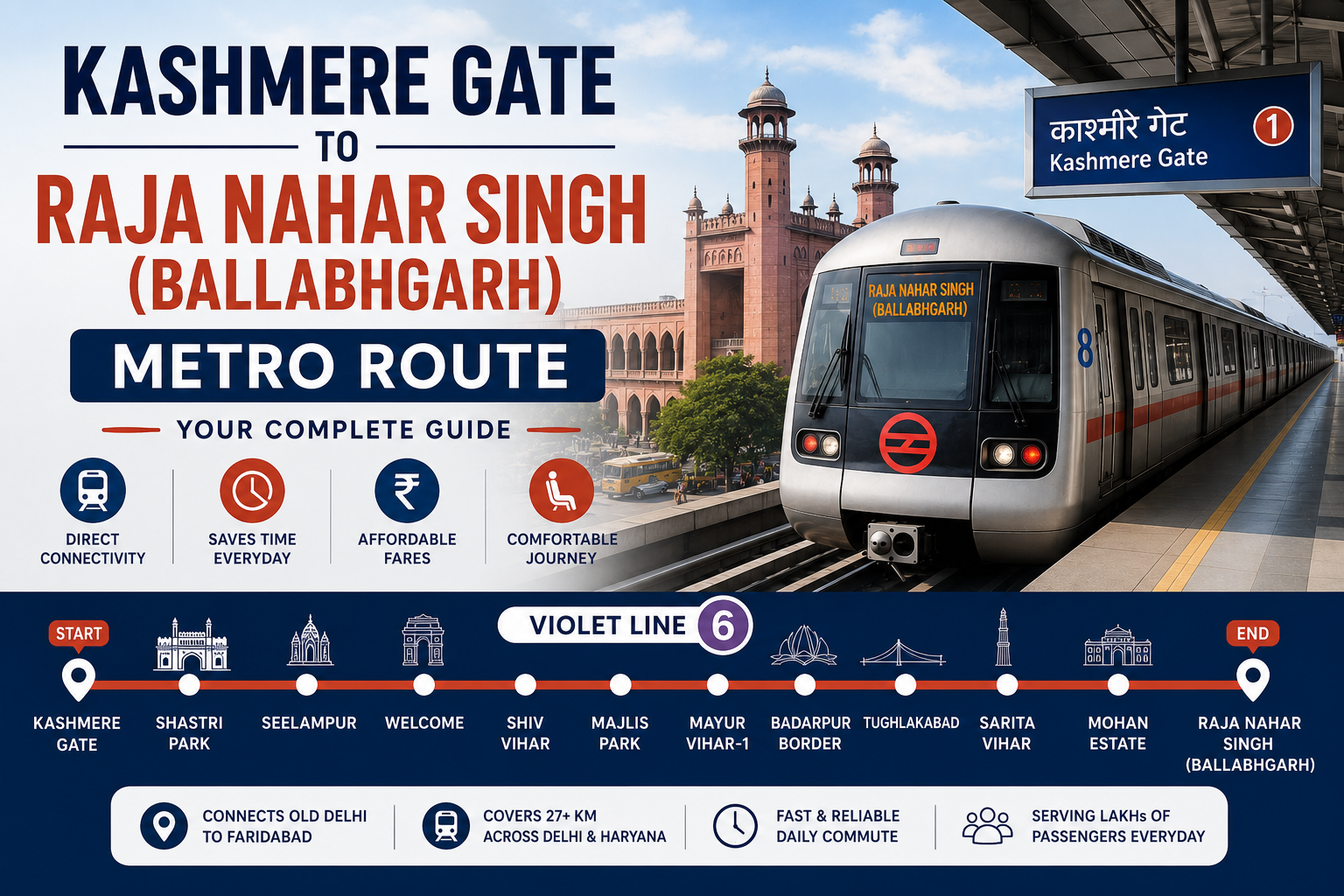
If you’ve ever stood on the platform at Kashmere Gate wondering how far the Violet Line actually goes, the answer might surprise you — it runs all the way down to Ballabhgarh in Faridabad, crossing an entire state border along the way. The Kashmere Gate to Raja Nahar Singh route is, in fact, one of the longest single-line journeys you can take on the Delhi Metro without a single interchange, and it quietly connects two very different worlds: the old, crowded lanes of North Delhi and the fast-growing residential belt of Faridabad.
This guide walks through everything you’d actually want to know before making that trip — the stations you’ll pass, what it costs, how long to budget, and a few things that tend to catch first-time travellers off guard.
Route Snapshot
| What You Need to Know | Details |
|---|---|
| From | Kashmere Gate |
| To | Raja Nahar Singh (Ballabhgarh) |
| Line | Violet Line (Line 6) |
| Distance | Roughly 43–44 km |
| Stations on the way | 33 intermediate stops, 34 including your destination |
| Journey duration | About 80–90 minutes end to end |
| Change of trains | None — it’s a straight run on one line |
| Fare (token) | Around ₹60–64 |
| Runs under | DMRC |
Keep in mind that DMRC fares are revised from time to time, so treat the numbers above as a close estimate rather than gospel — it’s always worth glancing at the fare chart at the station or the DMRC app before you tap in.
Where Your Journey Begins: Kashmere Gate
Kashmere Gate isn’t just another stop — it’s one of the three-line junctions that make the whole Delhi Metro network hang together, with the Red, Yellow, and Violet Lines all meeting under one roof. Commuters arriving from places like Rithala, Shaheed Sthal, or the Yellow Line corridor toward Samaypur Badli often switch here to continue south toward Faridabad.
If you’re heading to Raja Nahar Singh, look for Platform 5, which serves Violet Line trains heading toward Ballabhgarh. The station itself is busy at almost any hour, so give yourself a few extra minutes to navigate the corridors, especially during office rush.
Where You’ll End Up: Raja Nahar Singh (Ballabhgarh)
At the other end of the line sits Raja Nahar Singh, the terminal station of the Violet Line and the gateway to Ballabhgarh. It’s an elevated station with straightforward exits leading toward the Ballabhgarh bus stand, local markets, and the road toward the Ballabhgarh railway station. If you’re continuing further into Faridabad or Palwal, this is usually where you’ll switch to an auto, e-rickshaw, or bus.
The Full Station List
Here’s every stop you’ll pass through on the Violet Line between Kashmere Gate and Raja Nahar Singh:
| # | Station |
|---|---|
| 1 | Kashmere Gate |
| 2 | Lal Quila |
| 3 | Jama Masjid |
| 4 | Delhi Gate |
| 5 | ITO |
| 6 | Mandi House |
| 7 | Janpath |
| 8 | Central Secretariat |
| 9 | Khan Market |
| 10 | Jawaharlal Nehru Stadium |
| 11 | Jangpura |
| 12 | Lajpat Nagar |
| 13 | Moolchand |
| 14 | Kailash Colony |
| 15 | Nehru Place |
| 16 | Kalkaji Mandir |
| 17 | Govind Puri |
| 18 | Harkesh Nagar Okhla |
| 19 | Jasola Apollo |
| 20 | Sarita Vihar |
| 21 | Mohan Estate |
| 22 | Tughlakabad |
| 23 | Badarpur Border |
| 24 | Sarai |
| 25 | NHPC Chowk |
| 26 | Mewala Maharajpur |
| 27 | Sector 28 |
| 28 | Badkal Mor |
| 29 | Old Faridabad |
| 30 | Neelam Chowk Ajronda |
| 31 | Bata Chowk |
| 32 | Escorts Mujesar |
| 33 | Sant Surdas (Sihi) |
| 34 | Raja Nahar Singh (Ballabhgarh) |
Notice how the line quietly shifts character as it moves — the first stretch through Lal Quila and Jama Masjid runs underground through Old Delhi’s heritage zone, the middle section cuts through South Delhi’s office and shopping hubs like Khan Market and Nehru Place, and by the time you cross Badarpur Border, you’re riding an elevated track through Faridabad’s residential sprawl.
How Much Will It Cost You
DMRC fares scale with distance, and a journey this long lands in the upper fare bracket.
| Payment Mode | Approx. Fare |
|---|---|
| Paper token/QR ticket | ₹60–70 |
| Smart (metro) card | ₹54–64 |
| Tourist card | Available for visitors |
The smart card isn’t just about saving a few rupees per trip — it also skips the token queue entirely, which matters a lot on a line this long, since you don’t want to be stuck in a line at Kashmere Gate during peak hours. If you’re making this trip more than once, it pays for itself quickly.
Budgeting Your Travel Time
Realistically, plan for 80 to 90 minutes door to door on the train itself, not counting walking time at either end. A few things can stretch that window:
- Rush hour crowding between 8–10 AM and 6–8 PM, particularly around Lajpat Nagar and Kalkaji Mandir
- Weekend footfall near Nehru Place and Central Secretariat
- Train frequency, which thins out slightly late at night and on Sundays
If you’re catching a train, flight, or an important meeting on the other end, it’s worth padding your estimate by an extra 15–20 minutes.
First and Last Trains
| Service | Approximate Time |
|---|---|
| First metro | Around 5:30–6:30 AM |
| Last metro | Around 11:00 PM–11:30 PM |
Sunday and holiday schedules tend to start a little later, so if you’re planning an early trip on a Sunday, it’s worth double-checking the DMRC app rather than assuming weekday timings apply.
Interchange Points Worth Knowing
Even though this particular journey doesn’t require you to change trains, several stations along the way connect to other lines — useful to know if your actual destination is somewhere in between rather than the final stop.
| Station | Connects To |
|---|---|
| Kashmere Gate | Red Line, Yellow Line |
| Mandi House | Blue Line |
| Central Secretariat | Yellow Line |
| Lajpat Nagar | Pink Line |
| Kalkaji Mandir | Magenta Line |
This is part of what makes the Violet Line so useful — it acts almost like a spine that ties together several other corridors across the city.
What You’ll Find at Raja Nahar Singh Station
Since it’s a terminal station, Raja Nahar Singh is reasonably well equipped:
- Lifts and escalators for easier access
- Paid parking near the station
- Ticket counters and smart-card top-up points
- Security screening at entry
- Public restrooms
- Autos and e-rickshaws lined up right outside for the last mile
Is the Metro Actually the Better Choice Here
Given that this stretch covers over 40 km, it’s fair to ask whether driving might be quicker. In practice, road traffic between North Delhi and Faridabad — especially through Mathura Road and the Badarpur stretch — can easily eat up two hours or more during peak time, with no guarantee of finding parking once you arrive. The metro, by contrast, runs on a fixed schedule regardless of road congestion, stays air-conditioned through Delhi’s summer heat, and costs a fraction of what a cab ride over the same distance would run you. For a daily commute, that reliability tends to matter more than shaving off a few minutes.
Around Raja Nahar Singh Station
| Landmark | Roughly How Far |
|---|---|
| Ballabhgarh Bus Stand | ~1 km |
| Local markets | Walkable |
| Faridabad Industrial Area | 5–7 km |
| Schools and colleges | Close by |
A Few Practical Tips
- Get a smart card if you’ll be repeating this trip — it saves both money and time in queues.
- Try to avoid the 8–10 AM and 6–8 PM windows if your schedule allows it.
- Hold onto your token until you exit — you’ll need it to get through the gate.
- Keep an eye on your belongings, particularly around the busier interchange stops.
- The DMRC app (or Google Maps) gives live train timings, which helps when planning a tight connection.
Frequently Asked Questions
Do I need to change trains between Kashmere Gate and Raja Nahar Singh? No. Both stations sit on the Violet Line, so it’s a single, direct ride.
How many stations are there on this route? There are 33 stations in between, making 34 stops in total if you count Raja Nahar Singh itself.
What’s the fare for a one-way trip? Expect somewhere around ₹60–64 with a token, slightly less with a smart card.
How long does the full journey take? Around 80 to 90 minutes under normal conditions, though rush-hour crowding can add extra time.
What time does the first and last metro run? The first train leaves roughly around 5:30–6:30 AM, and the last one departs around 11:00–11:30 PM, with slightly different timings on Sundays.
Final Thoughts
The Kashmere Gate to Raja Nahar Singh route is a good example of what makes the Delhi Metro genuinely useful for long-distance intra-NCR travel — one line, no changeovers, and a predictable ride from the heart of Old Delhi straight into Faridabad. Whether you’re commuting for work, heading to college, or just making a one-off trip to Ballabhgarh, the Violet Line gets you there without the guesswork that road travel usually involves. Just remember that fares and timings can shift over time, so it’s always worth a quick check on the DMRC app before you head out.