
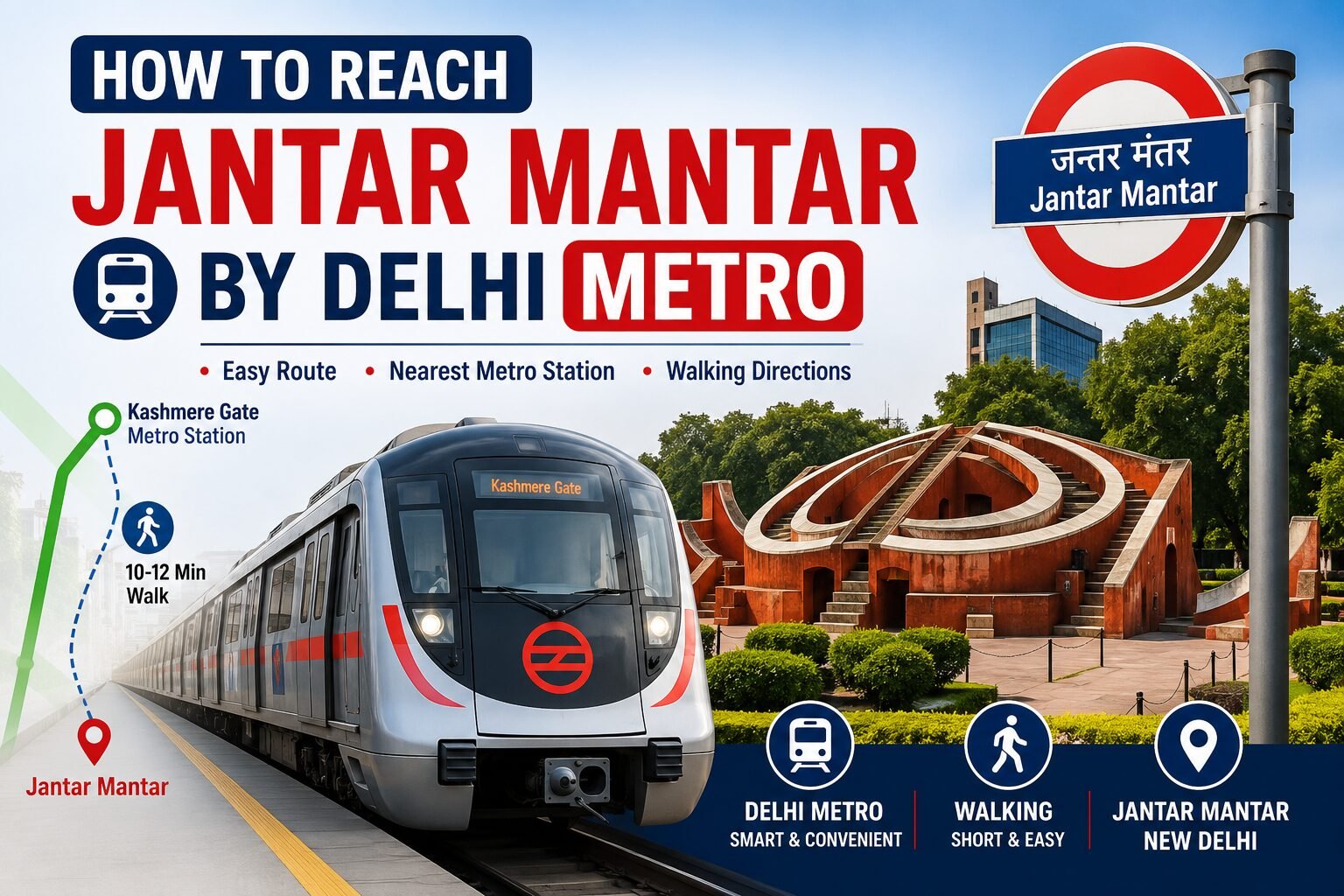
If you’re planning a trip to Jantar Mantar in the heart of Delhi, the metro is hands-down the easiest, cheapest, and most reliable way to get there. Roads around Connaught Place and Sansad Marg stay congested through most of the day, and parking nearby is limited at best. The metro skips all of that — no traffic, no hunting for a parking spot, just a short ride and a five-to-fifteen-minute walk (or a quick auto ride) to your destination.
This guide walks you through every metro route to Jantar Mantar, whichever part of Delhi or NCR you’re travelling from, along with fares, walking distances, and a few practical tips that’ll save you time once you step out of the station.
Quick Answer: Nearest Metro Stations to Jantar Mantar
| Metro Station | Line | Approx. Distance | Walking Time |
|---|---|---|---|
| Janpath | Yellow Line | ~0.3 – 0.6 km | 5–8 minutes |
| Patel Chowk | Yellow Line | ~0.85 – 1 km | 10–12 minutes |
| Rajiv Chowk | Yellow Line + Blue Line | ~1 – 1.5 km | 15–20 minutes (or a 5-minute auto ride) |
Janpath is technically the closest station, but Rajiv Chowk — being a major interchange between the Yellow and Blue Lines — tends to be the more convenient option if you’re coming from a part of Delhi that isn’t directly on the Yellow Line, simply because it gives you more ways to arrive.
Getting There by Yellow Line
The Yellow Line runs between Samaypur Badli in the north and HUDA City Centre in Gurugram, cutting straight through the centre of Delhi. If you’re travelling from anywhere along this line — Rohini, Model Town, Kashmere Gate, Chandni Chowk, or Gurugram — you’re in luck, because it’s a direct ride to Rajiv Chowk, Patel Chowk, or Janpath, with no interchange needed.
- Board any Yellow Line train heading towards HUDA City Centre (if coming from the north) or Samaypur Badli (if coming from Gurugram or South Delhi).
- Get down at Janpath for the shortest walk, or Patel Chowk if that’s more convenient for your onward direction.
- Exit through the gate that points towards Sansad Marg — station signage inside clearly marks this.
Getting There by Blue Line
The Blue Line connects Dwarka in the west to Noida Electronic City and Vaishali in the east, and it doesn’t run directly past Jantar Mantar. If you’re on this line:
- Get off at Rajiv Chowk and switch to the Yellow Line towards HUDA City Centre, then get down one stop later at Patel Chowk, or two stops later at Janpath.
- Alternatively, get off at Barakhamba Road, close to Connaught Place, and take a short auto ride (roughly 10–15 minutes) to Jantar Mantar.
Coming From Any Other Line
If you’re on the Pink, Magenta, Red, Green, or Violet Line, the simplest approach is to head towards the nearest interchange with the Yellow Line — usually Rajiv Chowk, Central Secretariat, or Kashmere Gate — and continue from there as described above. Delhi Metro’s route maps, available at every station and on the DMRC app, will show you the fastest interchange based on where you’re starting from.
From the Metro Station to Jantar Mantar
Once you’re out of the station, you have three ways to cover the last stretch:
- Walk it. From Janpath, it’s a flat, five-to-eight-minute walk along a well-lit stretch of road. From Patel Chowk, expect closer to ten to twelve minutes.
- Take an auto or e-rickshaw. Easy to find right outside every exit, typically costing somewhere between ₹20 and ₹50 for the short hop, depending on the station and driver. Agreeing on the fare before you get in is always a good habit in Delhi.
- Use a cab-hailing app. Slower than walking most of the time, given how short the distance is, but useful if you’re carrying luggage or travelling in a large group.
Metro Fares and Tickets
Delhi Metro fares are distance-based, so what you pay depends entirely on where your journey starts — typically somewhere between ₹10 and ₹60 for a one-way trip. A few ways to pay:
- Delhi Metro Smart Card – the most convenient option if you’ll be using the metro more than once; available at any station counter and rechargeable at machines or counters.
- QR-code tickets – bought through the DMRC Momentum 2.0 app or the ticket vending machines at the station, handy for a one-off trip.
- Paper QR tokens – available at ticket counters for those who’d rather skip the app.
Keep your ticket handy until you’ve exited the destination station — you’ll need to tap or scan it again on the way out.
A Few Practical Tips
- Security check is standard. Like every Delhi Metro station, entry involves a baggage scan and a frisking check. It only takes a minute, but keeping sharp objects or oversized bags out of your carry can save you a back-and-forth at the gate.
- Pick the right exit gate. Both Janpath and Patel Chowk have multiple exits, and only one or two face Sansad Marg directly. Look for signage pointing towards “Jantar Mantar” or “Sansad Marg” as you come up the escalator — it saves a longer walk around the block.
- Gates in this area are occasionally regulated. Because Jantar Mantar sits close to Parliament Street and a few high-security zones, station staff sometimes redirect commuters to a different exit for short periods. It’s usually a minor detour rather than anything that affects your overall journey. If you’d like to check the current status of a specific gate before heading out, the DMRC’s official app and social media handles are updated in real time.
- Avoid peak office hours if you can. Trains between 8:30–10:30 AM and 5:30–8 PM on weekdays get packed. Travelling slightly outside these windows makes for a far more comfortable ride.
A Bit About Jantar Mantar Itself
Jantar Mantar isn’t just a convenient landmark address — it’s one of Delhi’s more remarkable pieces of history. Built in 1724 by Maharaja Sawai Jai Singh II of Jaipur, it’s one of five astronomical observatories he constructed across India (the others are in Jaipur, Ujjain, Varanasi, and Mathura), and it remains the largest of the lot. The complex houses over a dozen geometric stone instruments — including the towering Samrat Yantra sundial — used to track the sun, moon, and stars with surprising precision, long before telescopes were part of the picture.
It sits right on Sansad Marg, in the same stretch of central Delhi as Connaught Place, which makes it an easy stop to fold into a longer day out in the area.
Visiting Information
Jantar Mantar is generally open all seven days of the week, from early morning until early evening — though exact opening and closing times, along with entry fees for Indian and foreign visitors, have been revised a few times over the years by the Archaeological Survey of India. It’s worth double-checking the current timings and ticket price on the official ASI website or at the counter on the day of your visit, rather than relying on a number you happened to read online.
Nearby Places Worth Combining With Your Visit
Since you’re already making the trip, a few nearby spots are worth folding into your plan:
- Connaught Place – roughly a kilometre away, Delhi’s iconic circular market packed with cafés, bookstores, and shopping options.
- Janpath Market – a favourite for street shopping, right next to Janpath metro station.
- Agrasen ki Baoli – a striking 14th-century stepwell around 2 km away, easily reached by a short auto ride.
Frequently Asked Questions
Which is the nearest metro station to Jantar Mantar? Janpath, on the Yellow Line, is the closest — roughly 500 metres away. Patel Chowk, also on the Yellow Line, is a close second.
How do I get to Jantar Mantar from Rajiv Chowk? Exit Rajiv Chowk and take a short auto or e-rickshaw ride (around 10–15 minutes), or continue one to two stops further on the Yellow Line to Patel Chowk or Janpath and walk from there.
Can I walk from the metro station to Jantar Mantar? Yes — from Janpath, it’s a comfortable five-to-eight-minute walk. From Patel Chowk, it’s closer to ten to twelve minutes.
Is there parking available near Jantar Mantar? Space is limited and traffic in the area is heavy for most of the day, which is exactly why the metro is the more practical choice for most visitors.
Is the metro station near Jantar Mantar ever temporarily closed? Occasionally, specific gates are regulated for short periods due to the area’s proximity to high-security zones. This doesn’t happen often, and station staff will always direct you to an alternative usable exit if it does.
Travelling to Jantar Mantar doesn’t need to be complicated — hop on the Yellow Line, get off at Janpath or Patel Chowk, and you’re a short walk away from one of Delhi’s most fascinating historical sites. For more metro route guides to other landmarks around Delhi, browse the rest of IndMetro.