If you’ve just stepped off a train at New Delhi Railway Station and Hauz Khas is your next destination, you’re in luck. Out of all the cross-city routes on the Delhi Metro, this is one of the simplest. There’s no interchange to worry about, no running between platforms, and no second-guessing which line to switch to. You board once, sit back, and get off at Hauz Khas.
Whether you’re a student heading toward IIT Delhi, a first-time visitor to the city planning an evening at Hauz Khas Village, or just someone who wants to skip Delhi’s traffic altogether, here’s a complete breakdown of the route — the line to take, the stations in between, the fare, the timings, and a few things that are worth knowing before you actually make the trip.
Quick Route Summary
| Detail | Information |
|---|---|
| Metro line | Yellow Line (Line 2) |
| Interchange required | None — it’s a direct route |
| Distance | Approx. 11.4 km |
| Journey time | Roughly 20–22 minutes |
| Total stations on the route | 11, including New Delhi and Hauz Khas |
| Token / UPI fare | Approx. ₹30–33 |
| Smart card fare | About 10% cheaper than token fare |
| First metro | Around 5:30 AM (later, closer to 8 AM, on Sundays and national holidays) |
| Last metro | Around 11:30–11:45 PM |
| Train frequency | Every 2–5 minutes at peak hours, 5–8 minutes off-peak |
A quick disclaimer before we go further: DMRC revises fares and adjusts timings from time to time, so treat the numbers above as a reliable estimate rather than gospel. If you want the fare down to the last rupee, the DMRC app or the fare chart displayed at the station will have the current figure.
Which Metro Line Connects New Delhi to Hauz Khas?
Both New Delhi and Hauz Khas sit on the Yellow Line, which runs from Samaypur Badli in the north all the way down to HUDA City Centre in Gurugram. Because both stations fall on the same line, you don’t need to change trains at all — you simply board a Yellow Line train heading toward HUDA City Centre (or Millennium City Centre, as it’s now called) and ride it straight through to Hauz Khas.
This is worth pointing out because a lot of people assume any cross-city metro trip in Delhi involves at least one line change. This particular route is one of the exceptions, which is exactly why it’s such a popular one for commuters and tourists alike.
Getting From the Railway Station to the Metro Station
New Delhi Railway Station has two main sides — the Ajmeri Gate side and the Paharganj side — and the metro station entrance is easier to reach from the Ajmeri Gate side. If you’ve arrived on a platform closer to Paharganj, you’ll need to walk across the station complex (there are foot overbridges connecting the two sides) before reaching the metro entry gates.
Once you’re at the New Delhi metro station, look for the gates that lead toward the Yellow Line platforms. The station has multiple entry/exit gates, some of which connect directly to the railway station premises, so if you’re carrying luggage, it’s worth following the signage carefully rather than guessing — this is a busy interchange station and a wrong gate can mean extra walking with bags in tow.
Step-by-Step: Boarding the Right Train
- Enter the New Delhi metro station and get your ticket or tap your smart card/UPI at the gate.
- Head to the Yellow Line platform and look for trains going toward HUDA City Centre / Millennium City Centre Gurugram. This is the direction you want — not Samaypur Badli.
- Board the train and settle in for about 20 minutes.
- Get off at Hauz Khas station, which will be announced both visually on the display boards and over the announcement system.
- Exit through whichever gate matches where you need to go — Hauz Khas has separate gates for Hauz Khas Village, IIT Delhi, and the residential colonies nearby, so check the signboards before you climb the stairs.
Complete List of Stations Between New Delhi and Hauz Khas
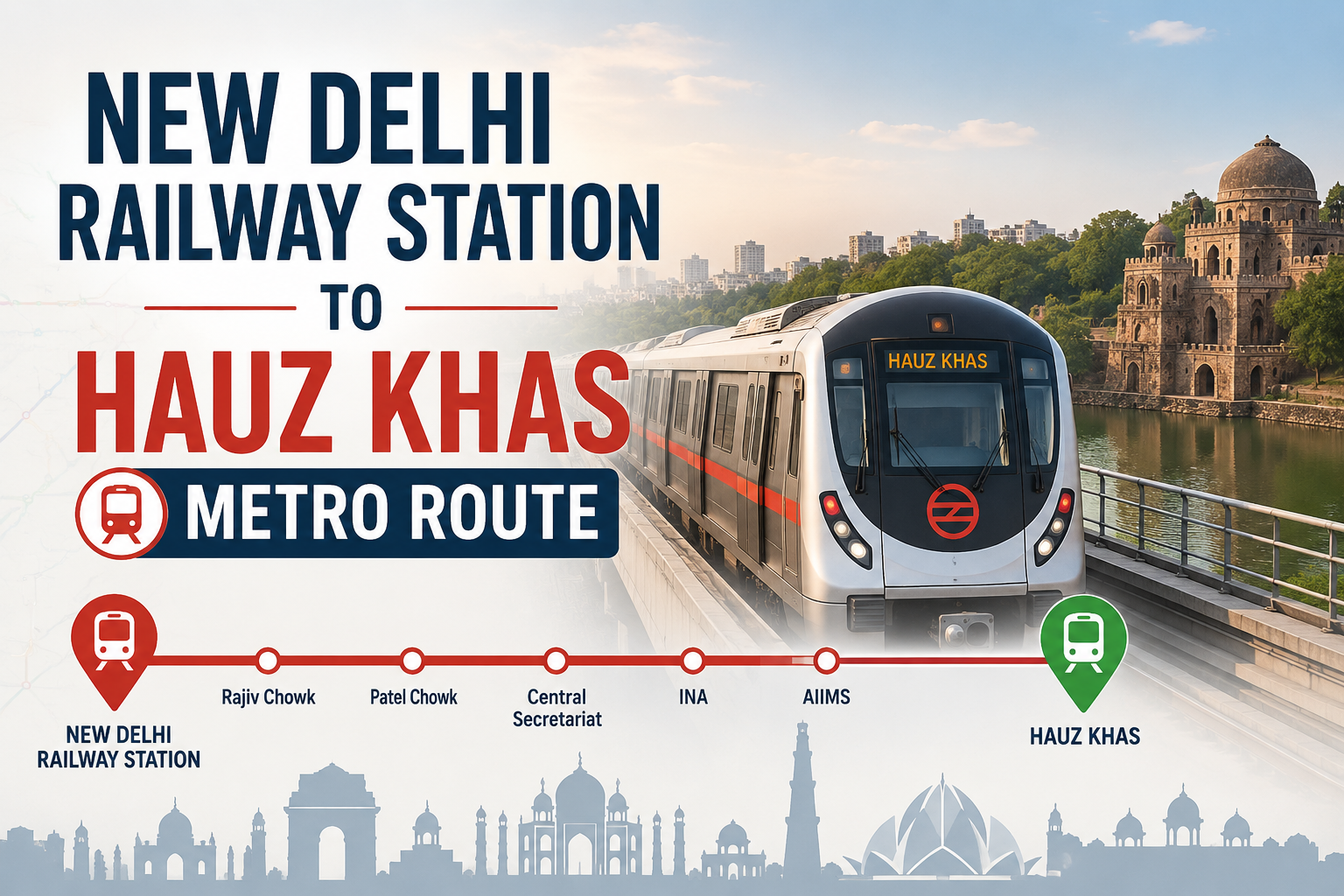
Here’s the full sequence of stations you’ll pass through, in order:
- New Delhi
- Rajiv Chowk
- Patel Chowk
- Central Secretariat
- Udyog Bhawan
- Lok Kalyan Marg
- Jor Bagh
- INA
- AIIMS
- Green Park
- Hauz Khas
A couple of these are worth knowing about even if you’re not stopping there. Rajiv Chowk is the busiest interchange in the entire network (it connects to the Blue Line), so expect the platform to be crowded when your train pulls in and pulls out. Central Secretariat connects to the Violet Line. INA is useful if you ever need to switch toward Dhaula Kuan or the airport side via a short walk-interchange. None of this affects your journey — you’re staying on the same train the whole way — but it helps to recognize the names as they scroll by.
Fare Details
Delhi Metro fares are distance-based, calculated in slabs, and the New Delhi–Hauz Khas stretch (around 11.4 km) falls into the 5–12 km bracket. Based on the current fare structure, that works out to roughly ₹30–33 if you’re paying by token or UPI, and a bit less — around 10% off — if you’re using a metro smart card or NCMC card.
A couple of things that can affect what you actually pay:
- Smart cards get an automatic 10% discount on every trip, and DMRC has also rolled out extra off-peak discounts during quieter hours (generally before 8 AM, between noon and 5 PM, and after 9 PM on weekdays), so it’s worth tapping in with a card rather than buying a token if you commute on this route regularly.
- Tourists who plan to hop on and off the metro a lot in a single day might find a one-day or three-day tourist card more convenient than buying individual tokens for every ride.
- Children below a certain height/age usually travel free, so if you’re travelling with a toddler, you generally won’t be charged for them.
Since fare revisions do happen periodically, it’s a good habit to glance at the fare chart at the ticket counter or check the DMRC app right before you travel, especially if you’re budgeting a trip down to the rupee.
Timings and Train Frequency
Delhi Metro generally runs from around 5:30 AM to about 11:30–11:45 PM on weekdays, with trains arriving every 2 to 5 minutes during peak hours (roughly 8–10 AM and 5:30–8:30 PM) and every 5 to 8 minutes during the rest of the day. On Sundays and national holidays, services usually start later, closer to 8 AM, so plan accordingly if you’re catching an early train after a Sunday morning arrival at New Delhi Railway Station.
If you’re travelling late at night or very early in the morning, it’s worth checking the last-train timing for your specific direction on the DMRC app, since terminal stations sometimes run trains a little later than intermediate ones.
Tips for a Smooth Journey
- Get a smart card if you’re staying a while. It saves you from queueing at the ticket counter every time and pays for itself after a handful of rides thanks to the discount.
- Avoid peak hours with luggage. If you’re coming straight off a train with bags, try to avoid the 8–10 AM and 6–8 PM windows on this route — the Rajiv Chowk stretch in particular gets packed.
- Stand clear of the doors and let passengers exit before you board — obvious advice, but it makes a real difference during rush hour on this line.
- Keep valuables zipped up and in front of you, especially around the busier interchange stations along the way.
- Use the correct exit gate at Hauz Khas. Coming out the wrong side can add a noticeable amount of walking if you’re headed to the Village or Deer Park side.
What’s Around Hauz Khas Metro Station
Hauz Khas is one of those stations where it’s worth stepping out and exploring rather than rushing off somewhere else. A short walk from the station takes you to Hauz Khas Village, a maze of narrow lanes packed with cafes, boutiques, and rooftop restaurants — it’s especially lively in the evenings. Right next to it is the Hauz Khas Complex, home to a centuries-old madrasa, tomb, and mosque built around an old reservoir, with a deer park alongside it that’s a nice, quiet break from the city noise.
The station also sits close to IIT Delhi, so if you’re visiting the campus or dropping someone there, it’s a short auto or e-rickshaw ride away. And if you ever need to continue your journey further, remember that Hauz Khas isn’t just a Yellow Line stop — it’s also an interchange for the Magenta Line, which is handy if your next stop is somewhere like Botanical Garden or further along that corridor.
Frequently Asked Questions
Do I need to change trains between New Delhi and Hauz Khas? No. Both stations are on the Yellow Line, so it’s a single, direct ride with no interchange.
How many stations are there between New Delhi and Hauz Khas? There are 9 stations in between, making 11 stations in total if you count New Delhi and Hauz Khas themselves.
How long does the journey take? Around 20 to 22 minutes under normal conditions, though it can vary slightly depending on the time of day.
What’s the fare from New Delhi to Hauz Khas? Roughly ₹30–33 for a token or UPI ticket, and a little less with a smart card. Always double-check current rates since fares are revised periodically.
Which direction should I take on the Yellow Line? From New Delhi, board a train heading toward HUDA City Centre / Millennium City Centre Gurugram — that’s the direction that takes you to Hauz Khas.
Is Hauz Khas metro station accessible for people with disabilities? Yes, Delhi Metro stations, including Hauz Khas, are generally built with lifts and ramps for accessibility, though it’s worth checking with station staff if you need specific assistance.
Final Thoughts
Of all the metro routes in Delhi, New Delhi to Hauz Khas is about as straightforward as it gets — one line, no changes, and a journey time you can set your watch by. Whether you’re catching up with friends at the Village, exploring the old monuments in the Deer Park, or just passing through on your way to IIT Delhi, the Yellow Line will get you there without any fuss. Just keep an eye on the current fare and timings before you head out, and you’re good to go.