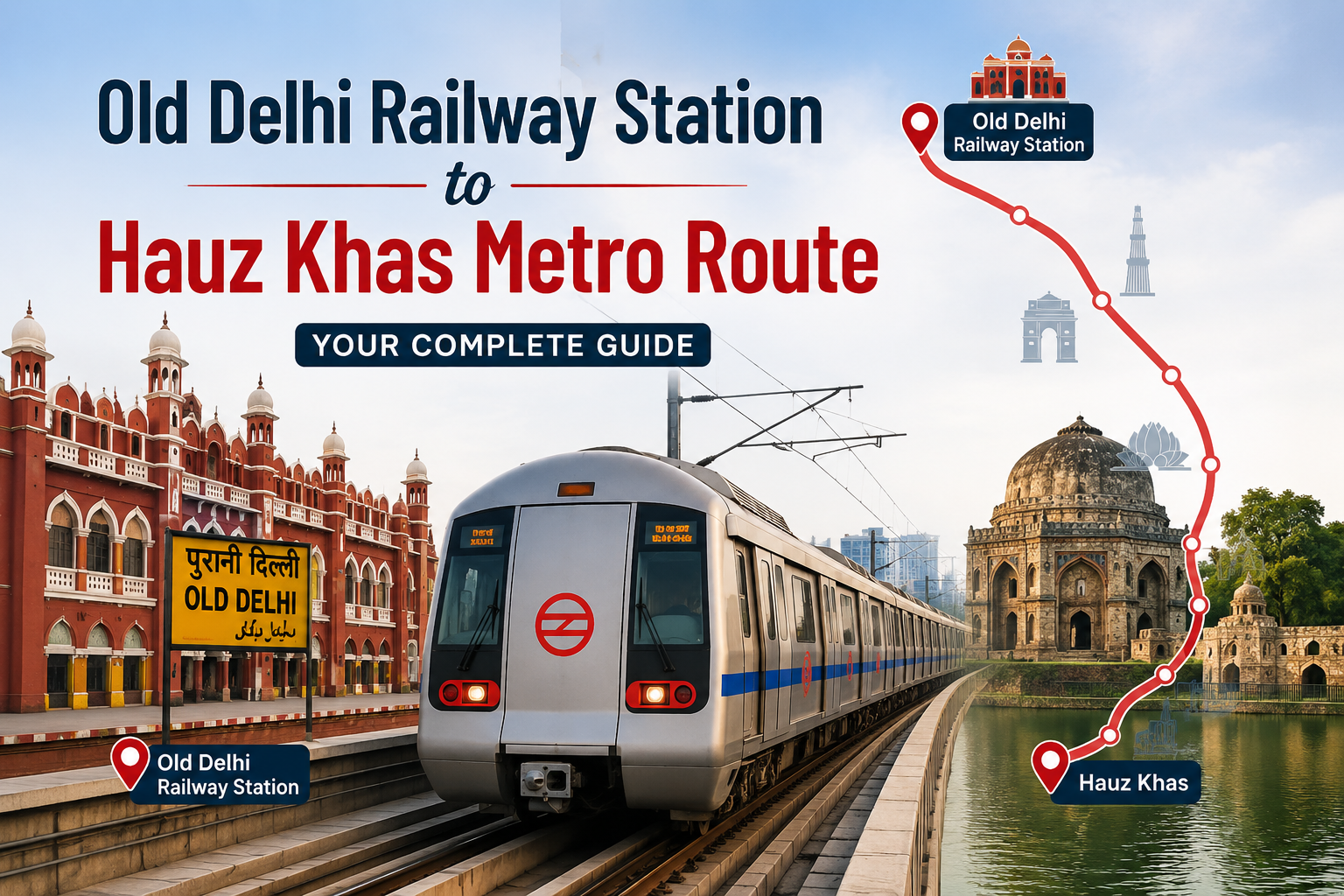
If you’ve just stepped off a train at Old Delhi Railway Station and you’re heading toward Hauz Khas for a college visit, a café-hopping evening, or a walk around Deer Park, here’s some good news — you don’t need to worry about confusing interchanges or multiple ticket purchases. This route runs entirely on the Yellow Line, start to finish, and it’s one of the more straightforward journeys the Delhi Metro has to offer.
In this guide, I’ll walk you through exactly how to get from the station to the metro, which platform to head for, every stop along the way, what it’ll cost you, and a few things worth seeing at both ends of your trip.
Route at a Glance
| Detail | Information |
|---|---|
| Nearest metro station to Old Delhi Railway Station | Chandni Chowk |
| Destination station | Hauz Khas |
| Metro line | Yellow Line (single line, no change) |
| Direction | Towards Millennium City Centre Gurugram |
| Distance | Approximately 13 km |
| Number of stations | 13 (including both ends) |
| Travel time | Roughly 28–31 minutes |
| Fare (token/QR ticket) | ₹43 |
| Fare (smart card) | Around ₹39 |
| Interchange required | None |
Getting From the Railway Station to the Metro
Old Delhi Railway Station — officially Delhi Junction — sits right next to Chandni Chowk, and the metro planners clearly had commuters like you in mind when they built this stretch of the Yellow Line. Chandni Chowk metro station is linked to the railway station through an underground subway, so you can walk across without ever stepping onto a busy road. Just follow the signage pointing toward the metro station once you’re out of the railway platforms — it’s a well-marked route, though it does get crowded during peak hours, especially with the Chandni Chowk market right above you pulling in its own daily rush of shoppers.
Once inside the station, buy your ticket (a QR ticket through the DMRC app or website, or a token at the counter) or simply tap in with a smart card or an NCMC/UPI-linked card if you already have one.
Boarding the Right Train
This is the part people sometimes get nervous about, but it’s genuinely simple here. At Chandni Chowk, the Yellow Line runs in two directions — one toward Samaypur Badli in the north, and the other toward Millennium City Centre Gurugram (the station that most Delhiites still call by its older name, HUDA City Centre) in the south. You want the Gurugram-bound platform. Once you’re on that train, you won’t need to get off until Hauz Khas — there’s no line change involved at any point.
Every Station Along the Way
Here’s the full list of stations you’ll pass through between Chandni Chowk and Hauz Khas:
- Chandni Chowk – your starting point, right by the Red Fort and the old walled city
- Chawri Bazar – one of the deepest stations on the network, close to Jama Masjid
- New Delhi – a major interchange with the Airport Express Line and New Delhi Railway Station
- Rajiv Chowk – the busiest hub on the system, for Connaught Place
- Patel Chowk
- Central Secretariat – interchange with the Violet Line
- Seva Teerth – recently renamed from Udyog Bhawan, near the government office belt
- Lok Kalyan Marg
- Jor Bagh
- Dilli Haat – INA – handy if you want to make a quick detour to the INA market or Dilli Haat
- AIIMS
- Green Park
- Hauz Khas – your final stop, and also an interchange point with the Magenta Line
Thirteen stations in total, and a good stretch of them cut right through the heart of the city — Old Delhi’s markets, the government quarter around Central Secretariat, and then the greener, quieter stretch through Jor Bagh and Green Park before you reach Hauz Khas.
What Will It Cost You?
Delhi Metro fares are calculated by distance, and this route falls in the 12–21 km slab. As of the current DMRC fare chart, that works out to:
- ₹43 if you’re paying by token or a one-time QR ticket
- Around ₹39 if you’re using a smart card, since smart card users get a 10% discount on every trip
- An additional discount kicks in if you travel during off-peak hours (before 8 AM, between noon and 5 PM, or after 9 PM on weekdays)
If you’re going to be using the metro more than once during your stay in Delhi, it’s worth picking up a smart card at any station counter — it pays for itself quickly and saves you the hassle of standing in the token queue every time.
First Train, Last Train, and How Often They Run
Yellow Line trains generally start running around 5:30 AM and continue until about 11:30 PM, though the very first and last services on Sundays and national holidays tend to begin roughly half an hour later than usual. During peak hours — think 8 to 11 AM and 5 to 9 PM — trains arrive every 2 to 4 minutes, so you’re rarely waiting long even if you miss one. Outside those windows, the gap stretches to around 5 to 8 minutes, which is still fairly reasonable by any city’s standards.
Before You Leave: Around Old Delhi Railway Station
If you’ve got a little time before your metro ride, or you’re planning to explore before heading south, Old Delhi has plenty to offer right around Chandni Chowk:
- Red Fort – the Mughal-era fort is a short walk from the station
- Jama Masjid – India’s largest mosque, near Chawri Bazar
- Chandni Chowk Market – lanes packed with spices, textiles, jewellery, and street food
- Paranthe Wali Gali – for anyone who wants a proper Old Delhi breakfast before the journey
Once You Reach Hauz Khas
Hauz Khas is a completely different flavour of Delhi compared to where you started, and that contrast is part of what makes this route interesting. Once you’re out of the station, you’ll find:
- Hauz Khas Village – narrow lanes filled with cafés, boutiques, and art galleries
- Deer Park – a peaceful green stretch right beside the metro station, good for an evening walk
- Hauz Khas Fort and the medieval madrasa complex – overlooking the old reservoir the area is named after
- IIT Delhi – just a short auto ride away, if that’s your destination
Since Hauz Khas is also where the Magenta Line crosses the Yellow Line, it’s a convenient point to continue onward if you need to reach places like Botanical Garden, Kalkaji, or the Noida side of the city.
A Few Tips to Make the Ride Smoother
- Avoid the 8–11 AM and 5–9 PM windows if you’re carrying luggage — these are the most crowded hours on this stretch, particularly around Rajiv Chowk and Central Secretariat
- The first and last coach of every train are reserved for women passengers
- Keep your ticket or smart card until you exit — you’ll need to tap out at Hauz Khas
- Download the DMRC app beforehand if you want to top up your smart card or check real-time train timings on the go
- If you’re travelling with heavy suitcases straight from the railway station, the elevators at both Chandni Chowk and Hauz Khas are useful — look for the accessibility signage at the entrances
Frequently Asked Questions
Is there a direct metro from Old Delhi Railway Station to Hauz Khas? Yes. The nearest metro station, Chandni Chowk, and Hauz Khas both sit on the Yellow Line, so the entire journey is direct with no interchange needed.
How long does the journey take? Around 28 to 31 minutes under normal conditions, though this can stretch a little during peak hours.
What is the metro fare for this route? ₹43 for a token or QR ticket, and roughly ₹39 if you’re travelling with a smart card.
Which direction should I board from Chandni Chowk? Take the train heading towards Millennium City Centre Gurugram, not the one going to Samaypur Badli.
Can I catch another metro line from Hauz Khas? Yes — Hauz Khas is an interchange station for the Magenta Line, useful if your final destination lies beyond the Yellow Line corridor.
What are the first and last train timings? Services generally run from about 5:30 AM to 11:30 PM daily, starting slightly later on Sundays and national holidays.
Final Thoughts
Few routes on the Delhi Metro map connect two such different worlds as smoothly as this one — from the crowded lanes of Old Delhi to the café culture of Hauz Khas — and you get to do it without changing trains even once. Just head to Chandni Chowk, board the train toward Millennium City Centre Gurugram, and settle in for a half-hour ride that takes you straight through the city’s history and into its present.
Fares, timings, and station names on the Delhi Metro are revised from time to time. It’s a good idea to cross-check details on the DMRC app or official website before you travel.