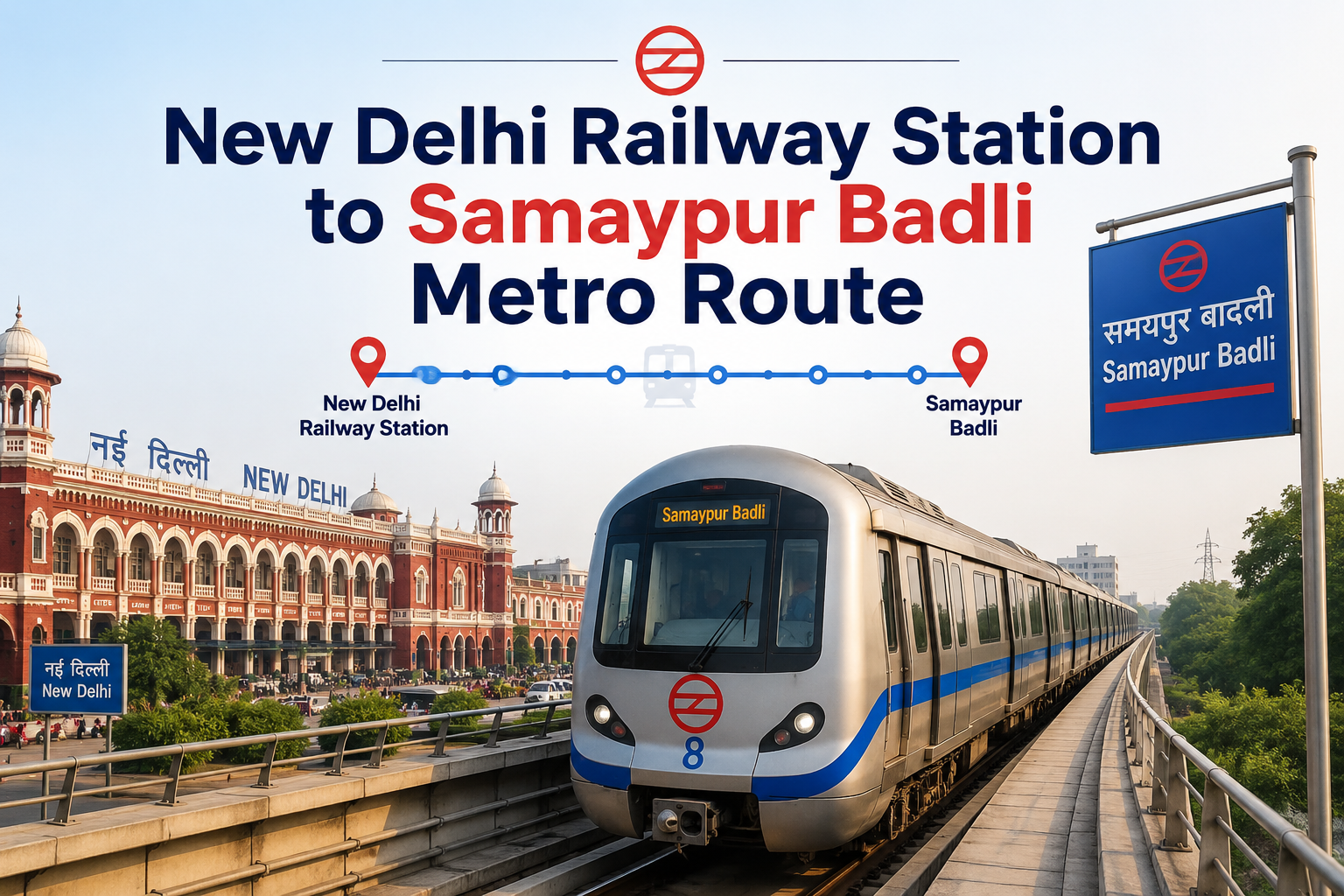
If you’re stepping out of New Delhi Railway Station and need to get to Samaypur Badli in North Delhi, you’re in luck — this is one of the simplest metro journeys in the entire city. No interchanges, no confusing platform changes, just one train on the Yellow Line that takes you straight from one end to the other.
I know how overwhelming NDLS can feel the moment you walk out with your luggage — the crowd, the auto-wallahs shouting fares, the general chaos of Paharganj side or Ajmeri Gate side. The metro is honestly the easiest way to skip all of that, and this route happens to be a straight shot with zero hassle. Here’s everything you need to know before you head down into the station.
Quick Route Summary
- Metro Line: Yellow Line (Line 2)
- Interchange required: None — it’s a direct route
- Total stations covered: 15 (including New Delhi and Samaypur Badli)
- Approximate distance: 25.5 km
- Approximate journey time: 30–35 minutes
- Approximate fare: ₹50 by token, around ₹45 with a smart card
Full List of Stations from New Delhi to Samaypur Badli
Once you board at New Delhi station heading toward Samaypur Badli, here’s the exact order of stations you’ll pass through:
- New Delhi
- Chawri Bazar
- Chandni Chowk
- Kashmere Gate
- Civil Lines
- Vidhan Sabha
- Vishwavidyalaya
- GTB Nagar
- Model Town
- Azadpur
- Adarsh Nagar
- Jahangirpuri
- Haiderpur Badli Mor
- Rohini Sector 18, 19
- Samaypur Badli (terminal station)
That’s 13 stations in between your start and end point. Since the entire stretch runs on the Yellow Line, you can board the train, find a seat if you’re lucky, and simply get off at Samaypur Badli without worrying about switching platforms anywhere in the middle.
How Long Does the Journey Actually Take
Going by the current timetable, the ride from New Delhi to Samaypur Badli takes roughly 30 to 35 minutes of actual travel time. Add another 5–10 minutes for walking to the platform, security check, and waiting for the train, and you’re looking at closer to 40 minutes door to door if you’re coming straight out of the railway station.
This can shift a little depending on the time of day. During peak hours the train itself doesn’t slow down, but the platforms and coaches get noticeably fuller, especially around Kashmere Gate and Azadpur, so boarding and getting off can take a few extra seconds each time the doors open.
Metro Fare for This Route
Delhi Metro fares are based on distance slabs, and this route falls in the 21–32 km bracket. That works out to:
- Token fare: around ₹50
- Smart card fare: around ₹45 (smart card users get a flat 10% discount on every trip)
- Off-peak discount: if you’re travelling before 8 AM, between 12 PM and 5 PM, or after 9 PM on a weekday, smart card users get an additional off-peak discount on top of the regular one
Fares do get revised by DMRC from time to time, so treat this as a close estimate rather than gospel. If you want the exact fare down to the rupee, the DMRC app or the fare chart displayed at the station will show it in real time before you tap in.
If you travel this route often — say for work or college — getting a smart card at the customer service counter is genuinely worth it. It saves you the token queue and pays for itself within a couple of weeks of regular travel.
First Train and Last Train Timings
Yellow Line services generally start early, around 5:15 AM, and run until roughly 11:45 PM. On Sundays and national holidays, the first train usually starts about 30 minutes later than on weekdays. If you’re planning an early morning or a very late-night trip, it’s worth double-checking the exact timing on the DMRC app or the notice board at the station, since these can shift slightly with operational changes.
How Frequently Do Trains Run
You won’t need to wait long on this line. During peak hours — roughly 8 to 10 AM and 5:30 to 8:30 PM — trains arrive every 3 to 5 minutes. Outside of peak hours, the gap stretches out to somewhere between 8 and 12 minutes. Either way, this is one of the busiest and most frequently serviced corridors on the entire Delhi Metro network, so you’re rarely standing on the platform for too long.
Which Platform to Use at New Delhi Station
New Delhi metro station has multiple gates, and it also connects to the Airport Express Line, so it’s easy to end up on the wrong side if you’re not paying attention. Once you’re inside the Yellow Line section, look for signage that says “Towards Samaypur Badli” — this tells you which platform to stand on. The Yellow Line here runs in two directions: one heads south toward Millennium City Centre Gurugram, and the other heads north toward Samaypur Badli, so make sure you’re reading the direction board before boarding, not just the line colour.
What You’ll Pass Along the Way
One of the nice things about this particular stretch is that it cuts right through some genuinely interesting parts of Delhi.
Chandni Chowk comes just two stops after New Delhi, and it’s worth knowing about even if you’re not stopping — this is your closest metro access point to Red Fort, Jama Masjid, and the food lanes of Old Delhi if you ever want to detour on a future trip.
Kashmere Gate is a major interchange station where the Red Line and Violet Line meet the Yellow Line. It’s also right next to the Kashmere Gate ISBT, one of Delhi’s biggest interstate bus terminals, so you’ll notice a lot of passengers getting on and off here with luggage.
Vishwavidyalaya sits right next to Delhi University’s North Campus, so expect a lot of student crowd, particularly during college hours.
Azadpur is home to Asia’s largest wholesale fruit and vegetable market, and this station tends to get busy early in the morning with traders and delivery staff.
By the time you cross Adarsh Nagar and Jahangirpuri, the train comes up above ground, and the ride starts feeling a lot more open compared to the underground stretch through central Delhi.
Facilities at Samaypur Badli Station
Samaypur Badli is an elevated terminal station, meaning the train ends its journey here — there’s nowhere further to go on this line. It’s wheelchair accessible, has parking available for those picking up or dropping off, and connects on foot to Badli Railway Station nearby, which is handy if you’re continuing your journey by local train instead of road.
A Few Tips for a Smoother Ride
- If you’re arriving at New Delhi station with heavy luggage, try to time your metro trip outside the 8–10 AM or 5:30–8:30 PM peak windows — the crowd on this line during those hours can make moving around with bags genuinely difficult.
- Keep your token or card handy right till the exit gate at Samaypur Badli — unlike some stations, there’s no shortcut around the AFC gates.
- If you’re heading somewhere near Chandni Chowk or Kashmere Gate anyway, it’s worth breaking your journey there for a bit rather than treating this purely as a point A to point B trip.
- Download the DMRC app before you travel. It gives live train timing and exact fare between any two stations, which is more reliable than going by memory or an old fare chart.
Frequently Asked Questions
Is there any interchange between New Delhi and Samaypur Badli? No. The entire route runs on the Yellow Line, so you board once at New Delhi and get off directly at Samaypur Badli.
How many stations are there between New Delhi and Samaypur Badli? There are 13 stations in between, making 15 in total once you count New Delhi and Samaypur Badli themselves.
What is the fare for this route? Roughly ₹50 by token and around ₹45 with a smart card, though it’s best to confirm the exact current fare on the DMRC app since fares are revised periodically.
How long does the journey take? Around 30 to 35 minutes of travel time, and closer to 40 minutes if you count walking and waiting at the station.
Can senior citizens or students get any fare discount on this route? Delhi Metro doesn’t offer a general senior citizen or student discount on regular fares, though children under a certain height/age travel free. It’s worth checking DMRC’s official concession policy directly if this applies to you, as these details do get updated occasionally.
Final Thoughts
For a city where getting from one end to another can eat up your entire afternoon by road, this particular metro route is refreshingly simple. One line, no interchange, a train roughly every few minutes, and under 40 minutes from the moment you step off your train at NDLS to the moment you’re out at Samaypur Badli. If you’re new to the Delhi Metro or just visiting the city, this is about as stress-free as a cross-city metro ride gets.