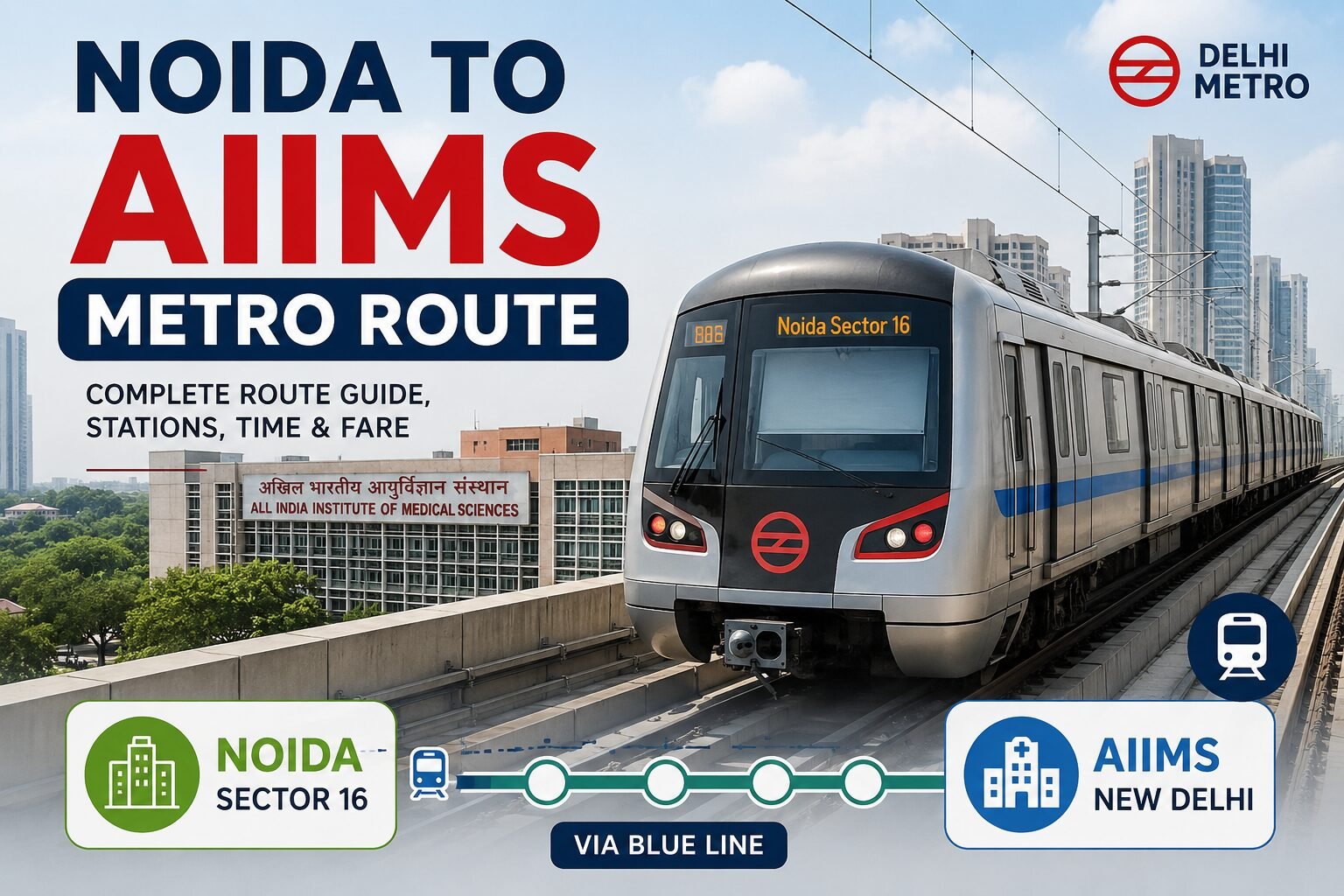
If you live in Noida and have an appointment at AIIMS, chances are you have already thought twice about driving there. Between the traffic near Ashram, the parking chaos around the hospital, and the sheer unpredictability of Delhi roads, the metro is usually the smarter choice. It is faster, it runs on a fixed schedule, and you don’t have to worry about where to park a car near one of the busiest hospitals in the country.
This guide walks you through the entire Noida to AIIMS metro journey — which lines to take, where you need to change trains, how much it costs, and a few practical tips that make the trip a lot smoother, especially if you’re travelling with an elderly patient or heavy bags.
Quick Route Summary
Here’s the short version before we get into the details:
- Lines used: Blue Line → Yellow Line
- Interchange station: Rajiv Chowk
- Number of interchanges: 1 (from most Noida stations on the Blue Line)
- Approximate travel time: 45 minutes to just over an hour, depending on your starting station
- Approximate fare: Roughly ₹40 to ₹55 for a single QR ticket or token, slightly less with a smart card
Noida’s metro stations — City Centre, Sector 18, Sector 16, Sector 15, Botanical Garden, and others further out like Sector 62 and Sector 61 — all sit on the Blue Line. AIIMS, on the other hand, is on the Yellow Line, right between Dilli Haat INA and Green Park. Since these two lines cross paths at Rajiv Chowk, that’s where nearly every Noida-to-AIIMS journey involves a single train change.
Step-by-Step Route: Noida to AIIMS by Metro
Taking Noida City Centre as an example starting point, here’s how the journey unfolds:
- Board a Blue Line train from Noida City Centre heading towards Dwarka Sector 21.
- Pass through Golf Course, Botanical Garden, Noida Sector 18, Noida Sector 16, Noida Sector 15, and New Ashok Nagar as the train crosses into Delhi.
- Continue through Mayur Vihar Extension, Mayur Vihar Phase-1, Akshardham, and Yamuna Bank.
- The train then moves through Indraprastha, Supreme Court (Pragati Maidan), Mandi House, and Barakhamba Road.
- Get down at Rajiv Chowk and switch to the Yellow Line platform heading towards HUDA City Centre.
- From Rajiv Chowk, pass through Patel Chowk and Central Secretariat.
- The next stops are Udyog Bhawan, Lok Kalyan Marg, and Jorbagh.
- Get off at Dilli Haat INA, and the very next station is AIIMS — your destination.
If you’re starting from a station closer to Delhi, like Botanical Garden or Sector 15, you’ll simply join this same route partway through and reach AIIMS a little quicker. If you’re coming from further out — say Sector 62, Sector 76, or the Noida Electronic City end — the journey will take a bit longer since you’re covering more distance on the Blue Line before you even reach Rajiv Chowk.
One thing worth knowing if you live in Greater Noida: stations from Sector 137 onwards fall on the Aqua Line, which is run separately by the Noida Metro Rail Corporation (NMRC), not DMRC. If you’re starting from one of these, you’ll first need to switch to the Blue Line at Noida Sector 52, and then make the second change at Rajiv Chowk. So that particular route involves two interchanges instead of one.
Why Rajiv Chowk Is the Interchange Point
Rajiv Chowk tends to make first-timers a little nervous simply because it’s one of the busiest stations on the entire network — it sits right under Connaught Place, so it sees heavy footfall through the day. But the actual changeover is simple: the Blue Line and Yellow Line platforms are connected by clearly marked walkways and escalators, and DMRC’s signage does most of the work for you. Just follow the yellow line boards once you get off, and you’ll land on the correct platform within a couple of minutes.
If you’re travelling during peak office hours — roughly 8:30 to 10:30 AM and 5:30 to 8 PM — expect the platforms and walkways to be crowded. It isn’t unmanageable, just worth factoring into your time if you have a fixed appointment at the hospital.
Metro Fare from Noida to AIIMS
Delhi Metro fares are distance-based, so the exact amount depends on which Noida station you start from. As a general guide:
- From nearby Blue Line stations (Botanical Garden, Sector 18, Sector 16, Sector 15): fares tend to fall in the ₹40–45 range
- From Noida City Centre: around ₹54
- From stations further out (Sector 61, Sector 62, Electronic City): fares run a little higher, closer to the network’s upper slabs
Paying with a smart card or the NCMC card usually gets you a small discount over a single-journey QR ticket, and fares are typically cheaper on Sundays and national holidays. Since DMRC does revise its fare slabs from time to time, it’s a good habit to double-check the exact fare on the DMRC app or at the station kiosk before you travel, rather than relying on any fixed number you read online — including this one.
First Metro and Last Metro Timings
Trains on the Noida Blue Line branch generally start around 5:40–6:10 AM and the last trains leave around 10:30–11:05 PM, though this varies slightly by station and by whether it’s a weekday or Sunday. If you’re heading to AIIMS for an early morning OPD queue or a late evening emergency, it’s worth checking the exact first/last train time for your specific starting station on the DMRC website or app, since timings can shift a little between stations on the same line.
Which Gate to Use at AIIMS Metro Station
This part trips up a lot of first-time visitors, so it’s worth spelling out. AIIMS metro station has four gates, and each one leads somewhere different:
- Gate 1 – opens towards AIIMS Hospital (main hospital building)
- Gate 2 – leads to Ansari Nagar (residential/campus area)
- Gate 3 – opens towards Safdarjung Hospital
- Gate 4 – leads to Vardhman Mahavir Medical College
If you’re visiting for OPD or hospital admission, Gate 1 is almost always what you want. If someone told you to meet them near Safdarjung instead, you’ll want Gate 3 — don’t assume the two hospitals share an entrance, because they don’t.
Tips for a Comfortable Journey
- Travelling with a patient or elderly family member? Try to avoid the 8:30–10:30 AM and evening peak windows if your appointment timing allows some flexibility. The coaches get genuinely packed during rush hour.
- Carrying medical files, bags, or equipment? Delhi Metro allows one bag free per passenger, with a small charge for additional bags, so keep essential documents in a single bag where possible.
- Get a smart card if you’ll be making this trip often — regular hospital visits, follow-up appointments, or a caregiver commuting daily will save both time and money compared to buying a fresh QR ticket every trip.
- Use the lift, not the escalator, if you’re assisting someone with mobility issues. Most major stations, including AIIMS and Rajiv Chowk, have functioning lifts near the gates.
- Keep some buffer time for Rajiv Chowk. It’s a big station, and even a smooth interchange can take 5–7 minutes of walking.
Frequently Asked Questions
Do I need to change trains to reach AIIMS from Noida? Yes, for almost every Noida station on the Blue Line, you’ll change trains once at Rajiv Chowk to get onto the Yellow Line towards AIIMS.
Which metro line is AIIMS on? AIIMS metro station is on the Yellow Line, between Dilli Haat INA and Green Park.
How long does it take from Noida to AIIMS by metro? Depending on your starting station, the journey usually takes anywhere between 45 minutes and just over an hour.
Is there a direct metro from Noida to AIIMS without any change? No, there’s currently no direct line connecting Noida stations to AIIMS. A single change at Rajiv Chowk is required from most Noida stations.
Which gate should I take at AIIMS metro station for the hospital? Gate 1 leads directly towards AIIMS Hospital. Use Gate 3 if you’re headed to Safdarjung Hospital instead.
Is the metro a good option for hospital visits compared to driving? For most people, yes — it avoids Delhi’s traffic and the parking crunch around AIIMS, and the schedule is predictable, which matters when you have a fixed appointment time.
Fares, timings, and schedules mentioned above are approximate and can change with DMRC updates. For real-time information before you travel, it’s best to check the official DMRC app or the notice boards at your metro station.