If you have ever stepped out of New Delhi Railway Station with a suitcase in one hand and a hospital file in the other, you already know the drill — auto drivers quoting triple the fare, traffic near Paharganj that barely moves, and a AIIMS appointment you cannot afford to miss. The good news is that you do not need any of that stress. The Delhi Metro connects both places directly, and once you know the drill, this journey becomes one of the easiest metro rides in the city.
This guide walks you through the entire New Delhi Railway Station to AIIMS metro route — which gate to use, how many stations you will pass, how much it costs, and a few small things that first-time travellers usually get wrong.
Quick Route Summary
| Detail | Information |
|---|---|
| Line to take | Yellow Line |
| Starting station | New Delhi (NDLS) |
| Ending station | AIIMS |
| Direction | Towards Millennium City Centre Gurugram (formerly HUDA City Centre) |
| Total stations | 9 (including New Delhi and AIIMS) |
| Interchange required | None — it’s a direct ride |
| Approx. distance | 8.7 km |
| Approx. travel time | 16–20 minutes |
| Approx. fare | ₹30 (token/UPI), slightly less with a metro smart card |
Step 1: Getting From the Railway Station to the Metro Station
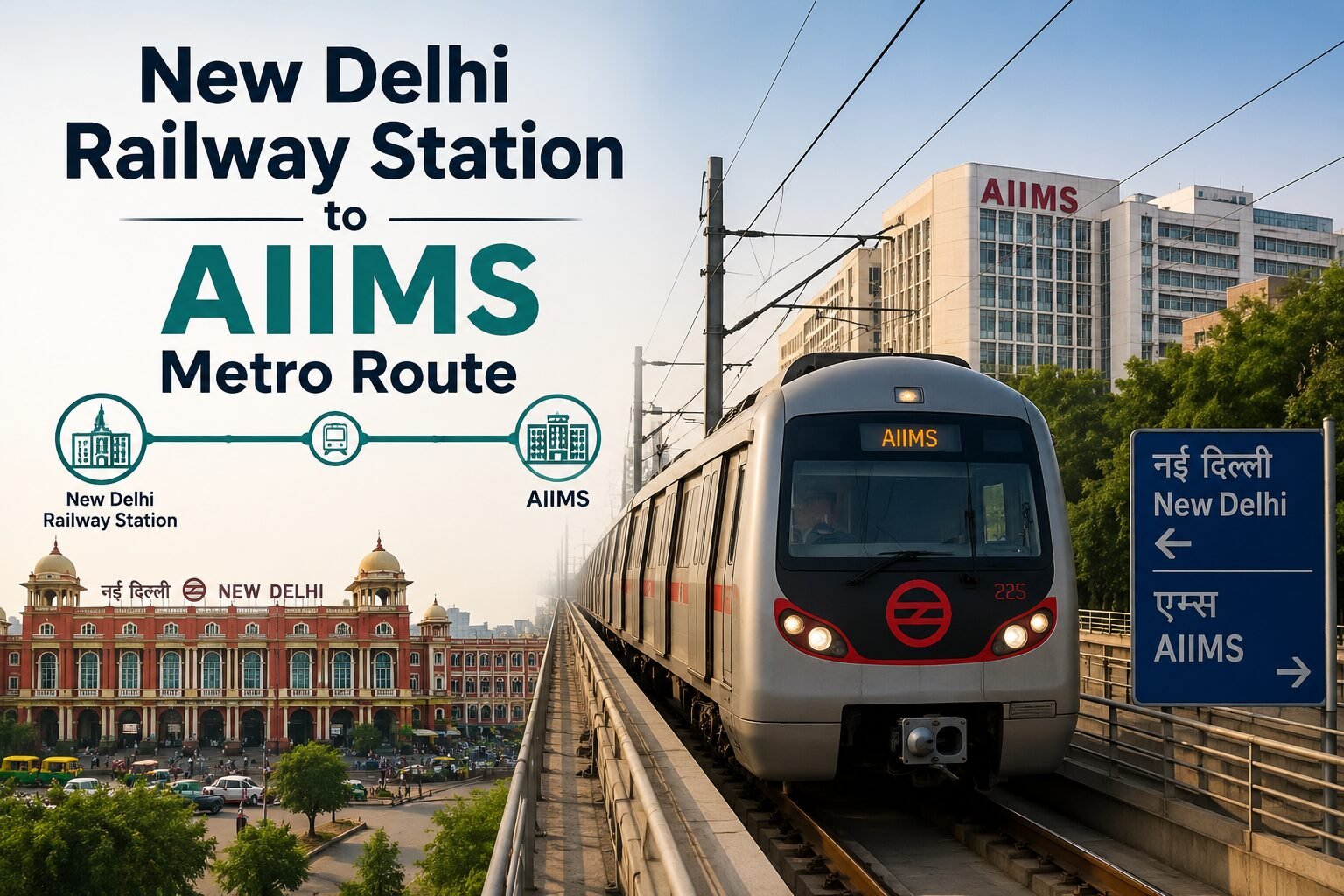
New Delhi Railway Station and New Delhi Metro Station are practically joined at the hip. The metro station sits right at the Ajmeri Gate side of the railway station, and since 2022 there has been a dedicated skywalk that links the two directly. If you are coming out of the railway station on the Ajmeri Gate side, just follow the signage — you will barely need five minutes to get inside the metro premises, security check included.
For anyone arriving on the Paharganj side of the station, it takes a little longer since you will need to walk around or use the foot overbridge, so factor in an extra 5–10 minutes if that is your exit point.
Step 2: Which Gate and Platform to Use
Once inside New Delhi Metro Station, head towards the Yellow Line. The station has multiple gates — Gates 1 and 2 open directly onto the railway station, Gate 3 leads towards Kamla Market, Gate 4 towards Rail Yatri Niwas, and Gate 5 connects to the Airport Express Line concourse in case you are catching a flight instead. Since you are heading to AIIMS, you simply need the Yellow Line platform.
Board the train from the platform going towards Millennium City Centre Gurugram — this is the southbound direction. If you accidentally board a train going towards Samaypur Badli, you are headed the wrong way, so double-check the destination board before you get on.
Step 3: The Journey — Stations You’ll Pass
This is a single, uninterrupted ride with no line change needed, which is honestly one of the best parts of this route. After boarding at New Delhi, the train will pass through:
- Rajiv Chowk
- Patel Chowk
- Central Secretariat
- Udyog Bhawan
- Lok Kalyan Marg
- Jor Bagh
- INA
And then you arrive at AIIMS, the ninth and final stop of this stretch. The whole ride takes roughly 16 to 20 minutes depending on the time of day and how many people are boarding at Rajiv Chowk, which tends to be the busiest interchange on this line.
Step 4: Fare and Ticket Options
For a distance of around 8.7 km, the fare works out to about ₹30 if you’re paying by token or QR/UPI ticket. If you already own a Delhi Metro smart card, you get a small discount, bringing it down to roughly ₹26–28. Given how often this route gets used by patients and families visiting AIIMS regularly, getting a smart card is genuinely worth it — it also skips the token queue, which can get long during peak hours.
Step 5: Exiting at AIIMS Station
AIIMS Metro Station is an underground station, and it was purpose-built to serve one of the busiest hospital campuses in the country, so it’s reasonably well designed for people who aren’t in a hurry to sprint up stairs. You’ll find escalators and lifts at multiple points, along with tactile pathways for visually impaired commuters.
The station has separate exits leading towards AIIMS Hospital, Safdarjung Hospital, Ansari Nagar, and Vardhman Mahavir Medical College. Gate numbering and exact directions have shifted a bit over the years as the station has been upgraded, so rather than memorising a gate number, just follow the overhead signage once you’re on the concourse — it clearly marks which exit leads where. If you’re travelling with an elderly patient or someone who needs extra time, station staff at AIIMS are used to helping visitors and are usually happy to point you the right way.
Once outside, autos and e-rickshaws are available right at the station, and DTC buses also stop close by if you need to go a bit further into the campus.
First and Last Trains
Yellow Line services on this stretch typically start early, around 5:00 AM, with the last trains running until roughly 11:30 PM, though timings can shift slightly on Sundays and public holidays. Since DMRC does occasionally revise schedules, it’s worth a quick check on the official DMRC app or website before you head out — especially if you’re catching either the first or last train of the day.
Why This Route Works So Well
A few things make this particular stretch stand out compared to other metro routes in Delhi:
- No interchange. You board once and get off once. For someone unfamiliar with the city, or travelling with luggage and a sick family member, this matters more than the few minutes it might save.
- Predictable timing. Road traffic between Connaught Place and AIIMS can swing from 20 minutes to over an hour depending on the day. The metro stays close to 16–20 minutes almost every single time.
- Frequent trains. Yellow Line trains run every few minutes during the day, so even if you miss one, the wait is short.
A Few Practical Tips
- Avoid peak hours if you can. Between 9–11 AM and 5:30–8 PM, this stretch gets crowded, particularly around Rajiv Chowk. If your AIIMS appointment allows flexibility, travelling slightly outside these windows makes for a much more comfortable ride.
- Keep small change or a smart card handy. Token counters can have queues during rush hour.
- Travelling with medical reports or bulky bags? Try to board from either end of the train rather than the middle coaches, which tend to get the most crowded.
- First time in Delhi? Google Maps and the DMRC app both show live train timings for this route, so you’re never really guessing.
Final Thoughts
The New Delhi Railway Station to AIIMS metro route is about as straightforward as Delhi Metro journeys get — one line, no changes, under 20 minutes, and a fare that won’t dent your pocket. Whether you’re rushing for a hospital appointment, visiting a patient, or just passing through the area, the Yellow Line has you covered end to end. Save this guide, and next time you land at New Delhi Railway Station, you’ll know exactly which platform to head for.